
By Christopher B. Daly
As I like to say: History keeps happening.
The events of recent days in the part of the world known as Iraq cannot be understood or explained without mastering a lot of history, going back well before the U.S. invasion and occupation. A good starting point for journalists covering the region (or merely pontificating about it) and for news consumers would be this map, drawn up in secret by the Great Powers who won World War I. In this historical map from 1919, British and French diplomats literally drew lines across the sand and decided how to divvy up the remains of the defeated Ottoman Empire.
(Don’t miss: the notation “secret” on the upper left.)

Map of British and French plans for dividing the Ottoman Empire.
(British Library)
This map shows how the European powers essentially created Syria (A) and Iraq (B) without regard for traditional ethnic, religious, tribal, or commercial interests. There was no plebiscite, no consultation with local leaders. That’s the fundamental (modern) problem in the region.
To zero in on Iraq at present, here’s a valuable recent map from the Washington Post, showing a much-needed degree of granularity that goes beyond the artificial “national” boundaries. At a glance, the grey area suggests the need for an independent Kurdistan. The green area from Baghdad to the Gulf suggests the contours of a smaller country populated by Shiites. The yellow areas may well make more sense as a new Sunni country that includes parts of Syria.
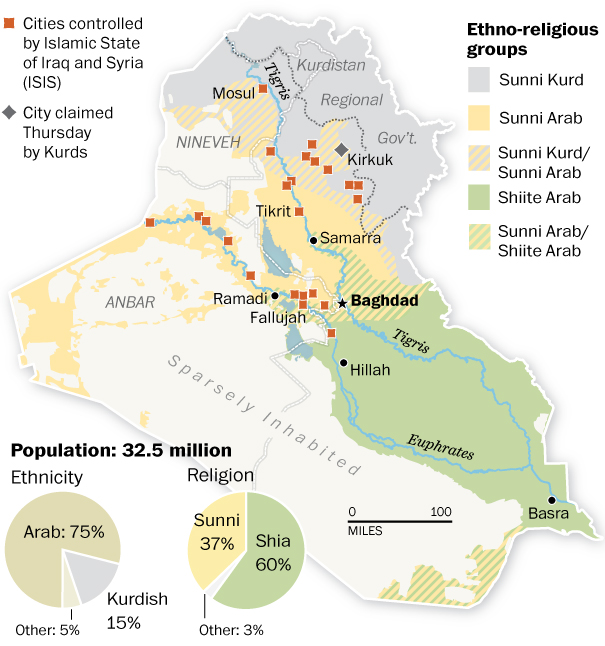
An ethno-religious map of Iraq.
Washington Post
My suggestion: Don’t listen to any journalist, analyst, or U.S. politician who could not intelligently discuss these maps for at least an hour in an informed way.
[My personal view: these are not real countries with genuine borders, so they cannot be effectively governed by anyone until borders are brought in line with social reality. In any case, this is not a U.S. problem. This region belongs to the people who live there. If they want to have a civil war or a religious war, they are entitled to have one. If any outside parties bear any responsibility, it would be the British and the French.]
 Prof Chris Daly's Blog
This is insightful on all points. While Americans worry about the difference between Red and Blue states, and Oliver Stone distorts history to treat the US as some sort of pathology, we are reminded constantly that even small diverse countries cannot last in most of the world, because they are little more than a conglomeration of tribes with a constant desire to kill each other–the Balkans; Rwanda; almost all of the Middle East; much of South Asia–or artificial countries carved out of empires which at best agree to peaceful divorces–Czechoslovakia.
LikeLike
Exactly the opposite is the case: http://gulfanalysis.wordpress.com/2013/12/30/dammit-it-is-not-unravelling-an-historians-rebuke-to-misrepresentations-of-sykes-picot/
LikeLike
And you can even find the counter argument in the first map you posted: the regions syria and erak already existed long before Sykes-Picot.
LikeLike