Prof Chris Daly's BlogThoughts on journalism and history2025-12-05T22:09:55Zhttp://journalismprofessor.com/feed/atom/WordPress.comprofdaly<![CDATA[WILLA CATHER: Pioneer of American Realism]]>http://journalismprofessor.com/?p=44692025-12-05T22:09:55Z2025-12-05T22:09:55ZContinue reading →]]>By Christopher B. Daly
Born on Dec. 7, 1873, during Reconstruction, Willa Cather lived until after World War II, spanning parts of two centuries. Although she is often associated with an older, rural America, the prize-winning novelist lived through the closing of the western frontier and became at home in a world of electricity and indoor lighting, as well as telephones, elevators, automobiles – a world much more like our own than like the older world depicted in her famous trilogy of novels about life on the prairies.
One scholar has framed the issue of Cather’s rise this way: “How, we ought to ask, does a girl raised on the Great Plains at the end of the nineteenth century become a major author in the canon of American literature?” Scholars have offered many answers, but they all ultimately fall short. The answer is hiding in plain sight: journalism. Willa Cather worked at newspapers and magazines until she gained the personal confidence, the professional connections, and the prose style that would carry her to the heights.
After that youthful career in journalism, Cather launched into an adult career in literature that brought her fame (and sales) as a novelist. In her fiction, Cather approached the leading edge of literary modernism, but then she balked, saying she would rather be thought of as part of the culture of the previous seven thousand years than to be thought of as part of the new culture that was emerging in the 1920s. She specifically rejected joining the ranks of her more experimental contemporaries like Gertrude Stein and James Joyce, much less the younger modernists like Hemingway and Woolf.
In other respects, though, Cather was a thoroughly, even radically, modern woman. As a girl in Nebraska, she embraced the bicycle and loved the freedom and mobility it gave her. She went to college and later moved to the country’s biggest city by herself. Never married, she was independent and became quite affluent entirely on her own. She was a woman who succeeded in both journalism and book publishing, fields that were still very much the domain of men.
She was also a lesbian in a world that had no category for her. For decades, Cather lived with her life partner, Edith Lewis, and the two traveled widely together. “ ‘Lesbian’ as an adjective accurately describes Cather and Lewis’s long relationship, and given their time and place, it is the right category for their individual identities,” according to Melissa Homestead, author of the newest and most thorough study of Cather’s life with Lewis. Cather’s sexuality – which was never visible or public – was long hidden, then fought over, then rediscovered and celebrated, and now more or less taken for granted.
During the early and mid-twentieth century, following her career in journalism, Willa Cather emerged as a prominent American novelist, who was both popular with the reading public and highly regarded by critics. Between 1912 and 1940, she published a dozen novels; all sold well, and one received the Pulitzer Prize for fiction. In those same years, she also published a collection of poems and three book-length works of non-fiction. In addition, she wrote hundreds and hundreds of shorter items, including reviews, criticism, and essays on writing and many more subjects.
She was herself the subject of several full-length and admiring profiles in major national magazines, and her work was praised by nearly all the major critics of her time. She was awarded honorary degrees from Columbia, Yale, Princeton, and Berkeley. After her death in 1947, several posthumous collections of her work appeared, about writing and other matters.
More recently, her letters have been collected and digitized. Although she has been in eclipse in recent decades among the general public and even among the reading public, Cather left one of the major legacies in American literature. Now, buoyed by growing interest in feminist and queer literary studies, Cather is enjoying a resurgence.
Like Twain, Cather was a literary realist, of a sort. Her writing, even at its most imaginative, has a disposition toward being reportorial. She was a great observer and recorder. Like Twain, she seemed to be a figure from the West in the eyes of the East Coast publishers, taste-makers, and cultural pooh-bahs. But she was not exactly a Western figure, either. Like Whitman, she contained multitudes.
Yes, she was a writer who celebrated the wide-open, empty grasslands and the (mostly) sturdy and practical settlers from northern and eastern Europe who fenced the land, broke the sod, and shaped the American heartland. But all the while, Cather herself was living in an apartment in the country’s most urban environment, Greenwich Village in New York City.
Cather was also a restless spirit, forever crossing boundaries. She moved from the prairies to Manhattan. She sometimes dressed as a boy, then tried to be typically feminine, then took on the role of a frank loving relationship with a woman, moving between gendered worlds for years. She worked in fiction and non-fiction, moving back and forth between genres for years, using pseudonyms (both male-sounding and female), frequently shifting her point of view. She traveled widely throughout her life, between New York and points north, south, east, and west. She was private and hard to pin down, elusive.
From her surviving letters, we can see a woman who was confident and could startle with her candor; at the same time, we can see a woman who did not want to be known in full by anyone. She wrote so much, over so many years, and yet she remains a blurry figure in some ways – often in motion to some distant place.
On the cusp of modernism, she recoiled and demanded that time stop. Now, a century on, her career invites us to explore the worlds she made and the issues that her career presents us with – from literary realism to sexuality, from West to East, from journalism to the arts. . .
[Adapted from the forthcoming book, The Democratic Art: The Role of Journalism in American Culture, by Christopher B. Daly]
[The following is an excerpt from a book in progress, titled The Democratic Art: The role of journalism in the rise of American Culture.]
HEM VS. GELL.
As writers, Ernest Hemingway and Martha Gellhorn both agreed, deep down, that writing fiction was a higher calling than reporting the news. Nevertheless, they both worked both sides of the street – journalism and fiction — for pretty much the duration of their careers.
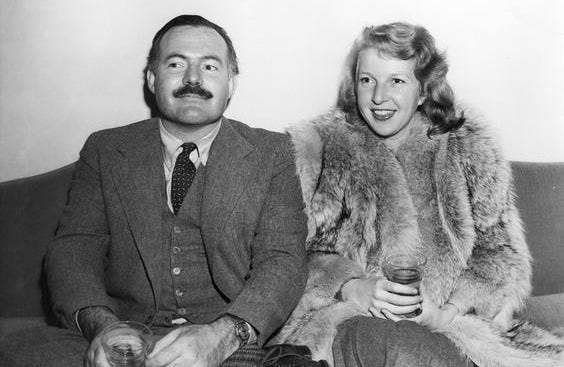
In this excerpt, I want to zero in on a crucial period in the careers of these two writers. The time is D-Day – or June 6, 1944 – and the ensuing Allied invasion of the beaches of Normandy. At the time, they were married – to each other. Martha Gellhorn, then 35, was the third wife (of four) to Ernest Hemingway, then 44.
During their years together, from the first meeting in late 1936 until their divorce in late 1945, the two writers were not only lovers (sort of). But they were also literary rivals (for sure!).
They usually avoided competing head-to-head, but there was one occasion when they both covered essentially the same story at essentially the same time – that was the fateful invasion of Normandy in June 1944. We might ask: Who wrote it better?
A close reading of the journalism they produced around D-Day rewards readers with insight into both writers’ strengths, their weaknesses, and their styles. In the research for my book, I was struck by how different their approaches were and by how superior the work turned in by Gellhorn was.
THE STORY
In the fateful spring of 1944, Gellhorn was covering the Allied campaign to liberate Italy.
Hemingway was mostly avoiding covering the war – apparently content with already having made a name for himself as a figure associated with war. He had been wounded as an ambulance driver in WWI, he had covered the war in Spain for U.S. newspapers, and he had written two important (and best-selling) novels about war.
He stayed home in Havana – drinking to the point where he often started with a Scotch around 10 a.m. and ended the night by sleeping in his clothes, on the floor.
As for Gellhorn, as soon as the U.S. military relented in 1943 and began allowing women to report from the war zones controlled by the Allies, Gellhorn flew to London. She quickly got accredited as a war correspondent thanks to Collier’s magazine, where she had been writing for years. She headed to Italy – the fifth war she covered, after Spain, the Sudetenland, Finland, and China.
That was impressive, but her absence did not sit well with the Great Writer she had left behind in Havana. Finally, in exasperation, Hem sent a cable to Marty in 1943 with a blunt question:
“ARE YOU A WAR CORRESPONDENT, OR WIFE IN MY BED?”
Her answer: she would keep covering the war, filing dispatches to Collier’s from Europe and Asia. Gellhorn observed later that “My crime, really, was to have been at war when he had not.”
Still, she wanted to find some role for Hemingway in covering the great conflict. She even suggested that he might pitch a series to Collier’s, the popular national weekly magazine that employed her. If it worked, she knew full well that her famous husband would outrank her among the magazine’s correspondents; she also knew that each magazine got only one slot to cover the front lines, so it might cost her.
There are differing versions of exactly what happened next. One view is that Gellhorn offered Hemingway the chance to take her place as Collier’s front-line war reporter. The other version is that he went around her back to editors at Collier’s and talked them into letting him big-foot her off the momentous story.
In any case. From her letters it appears that Gellhorn regretted the switch, and she certainly came to resent Hemingway for it.
To set the scene . . . both came home to Cuba for a bit before deciding to head to England for the big Allied invasion.
Women were then banned from most flights across the Atlantic. So, while Hemingway flew to England, Gellhorn was relegated to going by ship. As it turned out, she was the only woman and the only civilian on a Norwegian freighter full of explosives crossing the North Atlantic. Thus, her ship was a prime target for Nazi submarines prowling the ocean.
Hemingway arrived in London well ahead of Gellhorn, and he was soon up to his old tricks. Hemingway was introduced to Mary Welsh, an attractive younger American journalist (who also happened to be somewhat married). They were soon carousing around London, as Hemingway enjoyed getting to know Mary, who clearly adored him.
(As Mary wrote: “I wanted him to be the Master, to be stronger and cleverer than I; to remember constantly how big he was and how small I was.”)
On May 25, 1944, while Gellhorn was still crossing the Atlantic, Hemingway attended a very boozy party in London hosted by the photographer Robert Capa. Hemingway got a ride home, but the driver crashed the car into a water tower, and Hemingway was thrown against the windshield, resulting in another of his many traumatic brain injuries. Among his hospital visitors was Mary Welsh of TIME magazine, who brought daffodils.
When Gellhorn arrived in London, she quickly sized up the situation and decided she had really had it with Hemingway – with all of his drinking, his lying, his cheating, and his bullying. She would have demanded a divorce right then, but she felt bad for the 57 stitches so recently etched into Hemingway’s head, and so she waited.
All that spring, the Allies were planning their big push from England into France. All of London, indeed all of England, was abuzz about the impending invasion, the largest amphibious assault in world history. Everyone knew it was imminent, but no one knew exactly when or where. The details were top secret.
Throughout May and early June, soldiers, officers, journalists, and others all knew that something epic was coming, but much still depended on the tides and the weather. In the final days, journalists were quietly tapped by military handlers and vanished, one by one, into the staging areas.
HIS STORY
The Allied public relations staff assigned Hemingway to cross the Channel on a big Navy ship. According to the plan, when they neared the coast of Normandy, Hemingway would be lowered into a landing craft skippered by Lieutenant Robert Anderson.
In the story that he wrote for Collier’s, Hemingway behaves (and writes) as if he outranks Anderson – offering to steer the ship and, if needed, command the whole invasion. As usual, Hemingway makes himself the main protagonist of his story, if not the hero. In his version, they end up mostly bobbing around in their landing craft, searching for the intended landing spot.
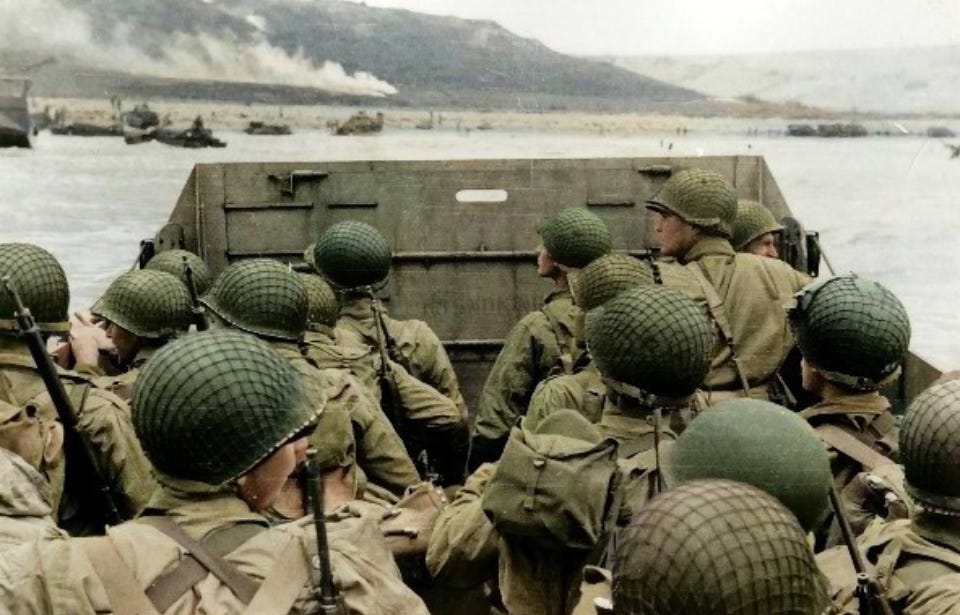
The landing craft, also known as Higgins boats, were 36 feet long, with sides made of plywood, equipped with an engine in the rear and a bow that could drop open to form a ramp. The boats could be driven into shallow water or right onto a beach.
The U.S. Navy purchased thousands of them to storm beaches from Normandy to Iwo Jima. Each boat could carry about three dozen soldiers. With the bow lowered, the men could charge down the ramp and into action. Those little boats tended to bounce around badly in choppy seas or high surf, and the wooden sides could not stop enemy fire. As a result, the ship’s bottom would often be shin-deep with a mix of seawater, blood, and vomit.
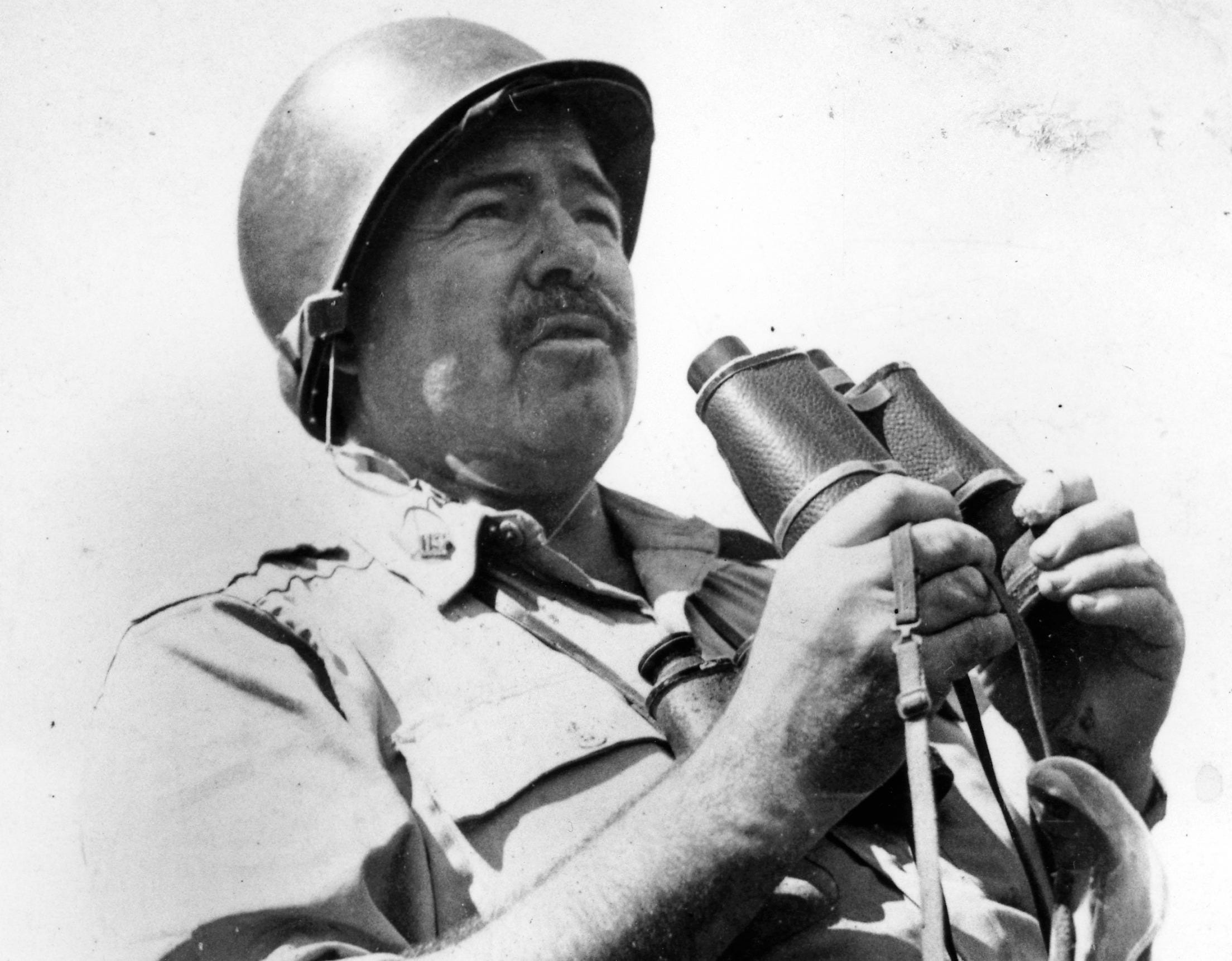
In Hemingway’s account, we see him using his own Zeiss binoculars, standing next to the skipper and conferring with him like a military peer. He quotes himself offering advice to Lt. Anderson, pointing out landmarks on the French coast, and trying to guide the boat to a section of Omaha Beach code-named Fox Green.
Thousands and thousands of words later, the landing craft gets near the beach and disgorges its platoon of fighting men.
Hemingway topped off his story with a deeply misleading final section. In it, he notes that the Germans kept firing their antitank guns and mortars from the cliffs above the beach. But the Americans kept coming.
In his final graf, Hemingway wrote: “It had been a frontal assault in broad daylight, against a mined beach defended by all the obstacles military ingenuity could devise. But every boat . . . had landed her troops and cargo. No boat was lost through bad seamanship. All that were lost were lost by enemy action. And we had taken the beach.” [emphasis added]
Now, that last line is really rich. When Hemingway wrote that “we” had taken the beach, he could not have meant that he was among the successful invaders, because he knew damn well that he had never left the boat — nor, much less, gone ashore.
To be fair, though, it was a common practice among U.S. journalists during World War II to say that “we” were doing this or that. So close was the identification of the press corps with the military corps, and so unified was the commitment to victory, that the usage became standard and drew almost no notice by 1944.
But Hemingway’s last statement – “We had taken the beach” – managed to be both true and misleading. It’s true that American troops had taken the beach, but by using the pronoun “we,” Hem was implying that he was among the “we” who had taken the beach. In all honesty, of course, it was they who took the beach.
In fact, Hem did not step foot on an invasion beach that day or any other. He made it back to London the same day and spent the night under clean sheets at the Dorchester Hotel in Mayfair.
Hemingway did not get to France until weeks later, safe and dry. Then, thanks to a U.S. general, the famous writer was provided with a captured German motorcycle that had a sidecar, plus a Mercedes convertible with his own driver.
HER STORY
As for Gellhorn, she was furious at Hemingway. As any journalist knows, the decent thing for him to have done would have been to find another magazine to write about D-Day for (Esquire, perhaps) and to have left Gellhorn in place as the top correspondent at Collier’s.
But no. He had to take her slot, then stash her at sea for three weeks while he partied in London and started romancing a new woman.
Gellhorn was also angry about the last-minute restrictions imposed by the Allied public relations command. They decreed that no women would be allowed to report on the first day of the invasion.
Instead, all the women reporters were shepherded into a giant press briefing center in London, along with any male reporters who were left behind. There, they were all locked in, and all fed the same official information about the invasion from Public Relations Officers.
As soon as the doors opened, Gellhorn began making her own way to the big story. Dressed in a standard-issue green correspondent’s uniform, she hitched a ride to one of the embarkation ports in southern England. There, she wrote a story on June 6 about the first batches of German POWs to reach England. But she was just getting started.
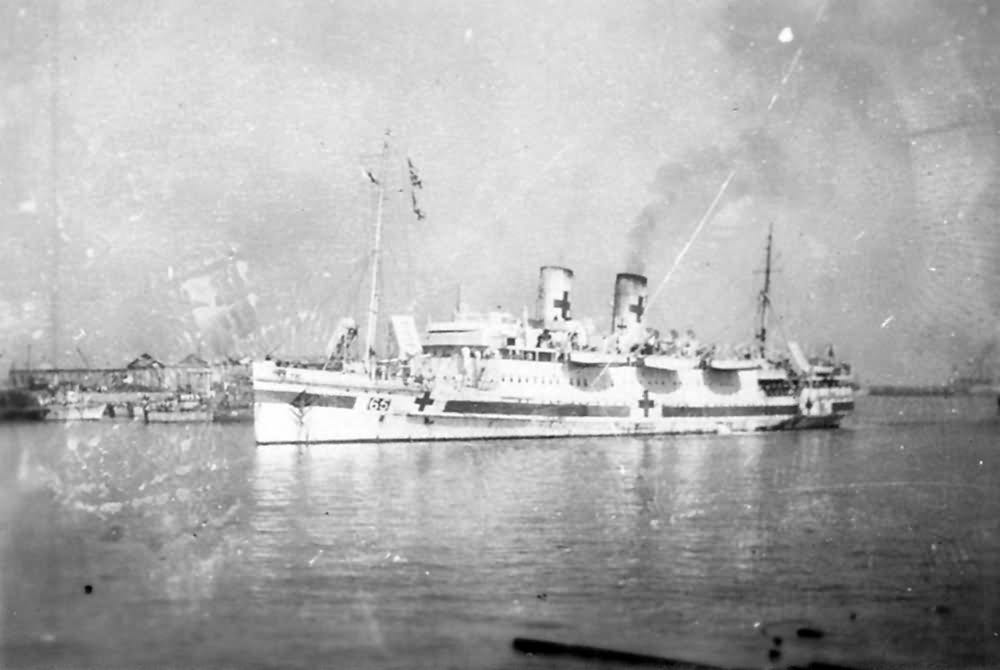
The next day, she found a hospital ship getting ready to cross the Channel to the invasion beaches. She talked her way on board, then locked herself in an empty bathroom and hid there until the ship was under way—so she could not be put ashore.
Painted white, the ship was under the command of the English merchant marine, not the U.S. Navy. As a result, Gellhorn was allowed to move about freely, to observe the action, and to interview nurses, doctors, patients, and prisoners.
The result was a magnificent piece of reporting.
In her story, Gellhorn began by noting that the white medical ship stood out in the armada of grey military ships “like a sitting pigeon” and that “there was not so much as a pistol on board in the way of armament.” Carefully, the medical ship picked a way through lanes in the sea that had been cleared of German mines.
“Then we saw the coast of France and suddenly we were in the midst of the armada of the invasion.” She noted the stunning number of ships as well as the planes and barrage balloons overhead (“looking like comic toy elephants”). Gellhorn also noted the constant booming of naval weapons all around.
Then, the first of the wounded began to arrive. Small ships called “water ambulances” were beginning to scour the surf and the beaches, looking for wounded combatants to bring them to the large floating hospital. There, a wooden box, “looking like a lidless coffin,” was lowered over the side, to bring the wounded aboard the hospital ship.
As it turned out, the first soldier was German. No matter. The medical team went right to work. Gellhorn went on to describe horrible injuries suffered by U.S. soldiers – gaping untreated wounds, shattered bones, missing body parts.
Around sunset, she went ashore herself at “Easy Red” beach with a medical team and set to work as a stretcher-bearer. She was now the only woman among the invading force of hundreds of thousands of men.
Staying in the narrow, marked lanes that had been cleared of mines, Gellhorn pitched in and helped move bodies in the dark to designated pickup spots.
All the while, German sniper fire and the occasional anti-aircraft battery kept up the roar of war. “Everyone agreed that the beach was a stinker and it would be a great pleasure to get the hell out of here sometime.”
Eventually, she decided to leave. She boarded a landing craft, at the edge of the beach. It was loaded with the wounded and was heading back out to the hospital ship, anchored in deeper water.
Gellhorn looked back toward the beach, where bonfires were roaring. “The beach, in this light, looked empty of human life, cluttered with dark square shapes of tanks and trucks and jeeps and ammunition boxes and all the motley equipment of war. It looked like a vast uncanny black-and-red flaring salvage dump, whereas once upon a time people actually went swimming here for pleasure.”
Gellhorn had gone ashore, under fire, and served as an eye-witness to history from one of the invasion beaches – all things that her famous, macho husband had not done.
Gellhorn had beaten Hemingway to France.
A CODA
Six months later, they were divorced. . . .
[THE BACKSTORY: For some years now, I have been working on a book that I am calling The Democratic Art. In it, I look at the careers of many of the top figures in American literature and the visual arts and draw attention to their apprenticeships in journalism.]
]]>0profdaly<![CDATA[The New Yorker magazine turns 100!]]>http://journalismprofessor.com/?p=44532025-02-20T15:00:11Z2025-02-20T15:00:11ZContinue reading →]]>The New Yorker expanded the scope of journalism far beyond the standard categories of crime, courts, politics and sports.
By Christopher B. Daly
Literate in tone, far-reaching in scope, and witty to its bones, The New Yorker brought a new – and much-needed – sophistication to American journalism when it launched 100 years ago this month.
As I researched the history of U.S. journalism for my book “Covering America,” I was drawn to the magazine’s origin story and the tale of its founder, Harold Ross.
In a business full of characters, Ross fit right in. He never graduated from high school. With a gap-toothed smile and bristle-brush hair, he was frequently divorced and plagued by ulcers.
Ross devoted his adult life to one cause: The New Yorker magazine.
For the literati, by the literati
Born in 1892 in Aspen, Colorado, Ross worked out west as a reporter while still a teenager. When the U.S. entered World War I, Ross enlisted. He was sent to southern France, where he quickly deserted from his Army regiment and made his way to Paris, carrying his portable Corona typewriter. He joined up with the brand-new newspaper for soldiers, Stars and Stripes, which was so desperate for anybody with training that Ross was taken on with no questions asked, even though the paper was an official Army operation.
In Paris, Ross met a number of writers, including Jane Grant, who had been the first woman to work as a news reporter at The New York Times. She eventually became the first of Ross’ three wives.
After the armistice, Ross headed to New York City and never really left. There, he started meeting other writers, and he soon joined a clique of critics, dramatists and wits who gathered at the Round Table in the Algonquin Hotel on West 44th Street in Manhattan.
Over long and liquid lunches, Ross rubbed shoulders and wisecracked with some of the brightest lights in New York’s literary chandelier. The Round Table also spawned a floating poker game that involved Ross and his eventual financial backer, Raoul Fleischmann, of the famous yeast-making family.
In the mid-1920s, Ross decided to launch a weekly metropolitan magazine. He could see that the magazine business was booming, but he had no intention of copying anything that already existed. He wanted to publish a magazine that spoke directly to him and his friends – young city dwellers who’d spent time in Europe and were bored by the platitudes and predictable features found in most American periodicals.
First, though, Ross had to come up with a business plan.
The kind of smart-set readers Ross wanted were also desirable to Manhattan’s high-end retailers, so they got on board and expressed interest in buying ads. On that basis, Ross’ poker partner Fleischmann was willing to stake him US$25,000 to start – roughly $450,000 in today’s dollars.
Ross goes all in
In the fall of 1924, using an office owned by Fleischmann’s family at 25 West 45th St., Ross got to work on the prospectus for his magazine:
“The New Yorker will be a reflection in word and picture of metropolitan life. It will be human. Its general tenor will be one of gaiety, wit and satire, but it will be more than a jester. It will not be what is commonly called radical or highbrow. It will be what is commonly called sophisticated, in that it will assume a reasonable degree of enlightenment on the part of its readers. It will hate bunk.”
The magazine, he famously added, “is not edited for the old lady in Dubuque.”
In other words, The New Yorker was not going to respond to the news cycle, and it was not going to pander to middle America.
Ross’ only criterion would be whether a story was interesting – with Ross the arbiter of what counted as interesting. He was putting all his chips on the long-shot idea that there were enough people who shared his interests – or could discover that they did – to support a glossy, cheeky, witty weekly.
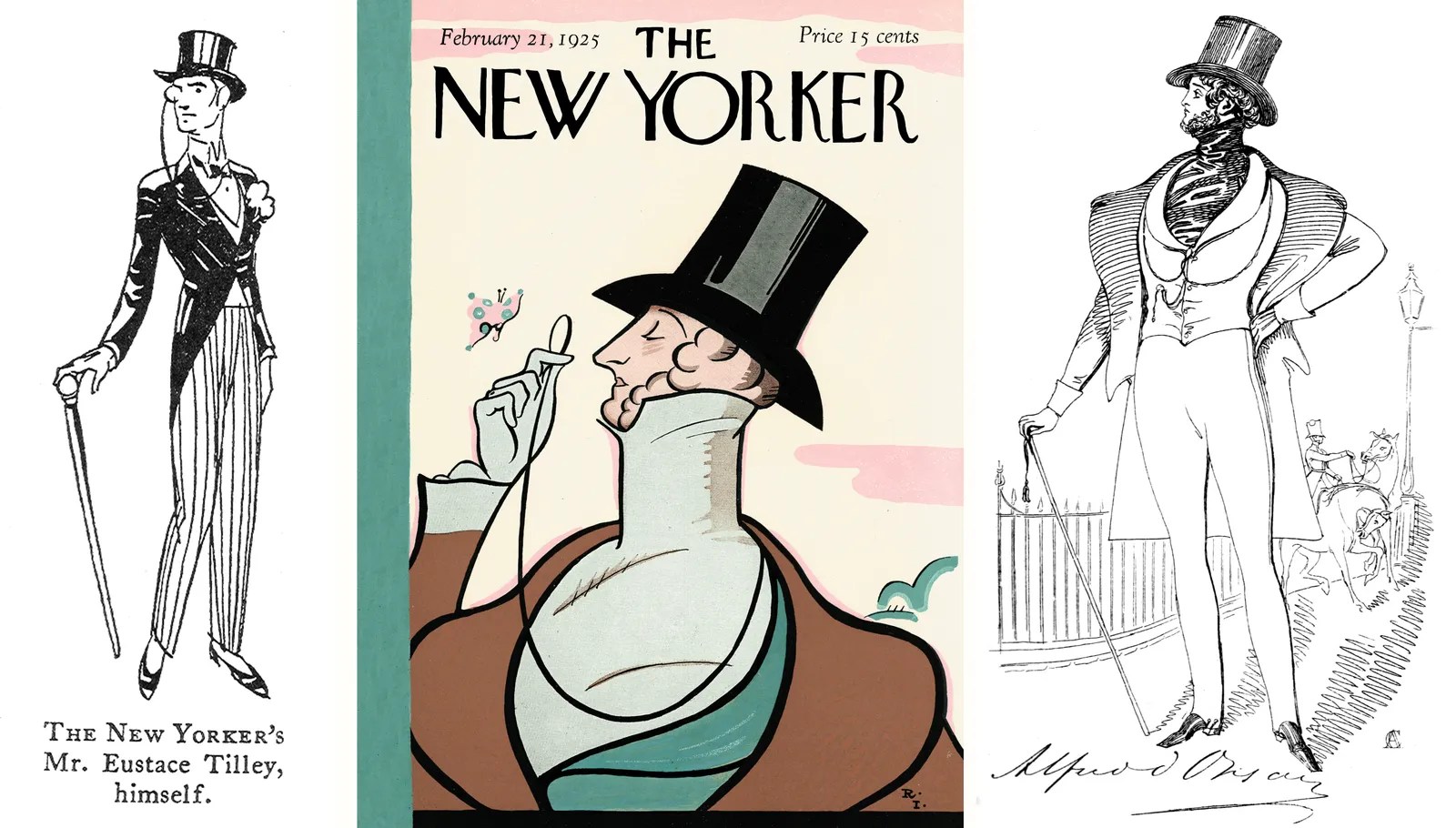
Ross almost failed. The cover of the first issue of The New Yorker, dated Feb. 21, 1925, carried no portraits of potentates or tycoons, no headlines, no come-ons.
Instead, it featured a watercolor by Ross’ artist friend Rea Irvin of a dandified figure staring intently through a monocle at – of all things! – a butterfly. That image, nicknamed Eustace Tilly, became the magazine’s unoffical emblem.
A magazine finds its footing
Inside that first edition, a reader would find a salamagundi of jokes and short poems. There was a profile, reviews of plays and books, lots of gossip, and a few ads.
It was not terribly impressive, feeling quite patched together, and at first the magazine struggled. When The New Yorker was just a few months old, Ross almost even lost it entirely one night in a drunken poker game at the home of Pulitzer Prize winner and Round Table regular Herbert Bayard Swope. Ross didn’t make it home until noon the next day, and when he woke, his wife found IOUs in his pockets amounting to nearly $30,000.
Fleischmann, who had been at the card game but left at a decent hour, was furious. Somehow, Ross persuaded Fleischmann to pay off some of his debt and let Ross work off the rest. Just in time, The New Yorker began gaining readers, and more advertisers soon followed. Ross eventually settled up with his financial angel.
A big part of the magazine’s success was Ross’ genius for spotting talent and encouraging them to develop their own voices. One of the founding editor’s key early finds was Katharine S. Angell, who became the magazine’s first fiction editor and a reliable reservoir of good sense. In 1926, Ross brought James Thurber and E.B. White aboard, and they performed a variety of chores: writing “casuals,” which were short satirical essays, cartooning, creating captions for others’ drawings, reporting Talk of the Town pieces and offering commentary.
As The New Yorker found its footing, the writers and editors began perfecting some of its trademark features: the deep profile, ideally written about someone who was not strictly in the news but who deserved to be better known; long, deeply reported, nonfiction narratives; short stories and poetry; and, of course, the single-panel cartoons and the humor sketches.
Intensely curious and obsessively correct in matters grammatical, Ross would go to any length to ensure accuracy. Writers got their drafts back from Ross covered in penciled queries demanding dates, sources and endless fact-checking. One trademark Ross query was “Who he?”
During the 1930s, while the country was suffering through a relentless economic depression, The New Yorker was sometimes faulted for blithely ignoring the seriousness of the nation’s problems. In the pages of The New Yorker, life was almost always amusing, attractive and fun.
The New Yorker really came into its own, both financially and editorially, during World War II. It finally found its voice, one that was curious, international, searching and, ultimately, quite serious.
Over the past century, The New Yorker had a profound impact on American journalism.
For one thing, Ross created conditions for distinctive voices to be heard. For another, The New Yorker provided encouragement and an outlet for nonacademic authority to flourish; it was a place where all those serious amateurs could write about the Dead Sea Scrolls or geology or medicine or nuclear war with no credentials other than their own ability to observe closely, think clearly and put together a good sentence.
Finally, Ross must be credited with expanding the scope of journalism far beyond standard categories of crime and courts, politics and sports. In the pages of The New Yorker, readers almost never found the same content that they’d come across in other newspapers and magazines.
Instead, readers of The New Yorker might find just about anything else.
]]>1profdaly<![CDATA[JO History syllabus / DALY]]>http://journalismprofessor.com/?p=44442024-10-04T16:49:45Z2024-10-04T16:49:45ZContinue reading →]]>JO 150 History & Principles of Journalism Prof. Chris Daly Boston University // Spring 2023
Contacts Prof. Daly can be reached by email: chrisdaly44@gmail.com Office: 704 Comm Ave./ Rm 307B Office Hours: Wed., 11-3. He/his/him
Required Readings 1. Covering America, 2d ed., by Christopher B. Daly. ISBN-13: 978-1558499119 2. The Elements of Journalism. By Bill Kovach and Tom Rosensteil. ISBN-13: 978-0307346704 3. Muckraking! By Judith and William Serrin. ISBN-13: 978-1565846814 4. Blackboard site. This site contains key documents as well as study guides, announcements, links, and other materials. Use it.
Objectives We will explore the major issues and themes in the history of journalism in America. The course will trace substantial changes in the practice of journalism and the key episodes in which the practice of journalism brought change to America. You will learn the most important eras in journalism history and the prevailing business model in each. In addition, you will learn the most important definitions of “news” across eras and across various media. We will consider how that history has shaped the current media ecology. The course will also investigate the major legal and ethical doctrines of journalism. It’s a great story!
HUB Learning Outcomes This course will enable you to develop a set of skills and habits of mind that derive from serious study of history and journalism, including: appreciation for how a historical perspective can enrich understanding of contemporary problems; the ability to analyze the value and limitations of various sources as evidence, including “primary” and “secondary” sources; a capacity to weigh multiple perspectives and evaluate the merits of competing interpretations, proficiency in constructing persuasive and evidence-based arguments in a written format. This course will meet BU Hub Learning Outcomes for Historical Consciousness. In particular, you will: — complete a series of essay tests that will ask you to make historical arguments about change over time. Lectures and readings will model these skills, and class discussions will also ask students to think in these ways. — encounter historical documents (laws, patent applications, maps, artwork), place them in historical context, and explain their significance.
Other Outcomes For students majoring in Journalism, this course fulfills a requirement and advances you toward your degree. It also prepares students for JO350 Media Law & Ethics, which is required of majors.
Educational strategy In this course, you will be expected to do the readings according to the weekly schedule provided below. That way, we can use class time for exploring concepts like censorship or “technological determinism,” hold discussions, and answer your questions.
How to succeed in this course –Come to class. –Keep current on the readings –Attend review sessions –Participate in class –Come to office hours
Your instructor: Chris Daly is a veteran journalist with experience in wire services, newspapers, magazines, books, and on-line. A Harvard graduate, he spent 10 years at The Associated Press. From 1989 to 1997, he covered New England for The Washington Post. He is the author of a narrative history of the U.S. news business titled Covering America. He holds a master’s degree in history from the University of North Carolina, where he was a co-author of Like a Family, a social history of the South’s industrialization. His writing has appeared in Atlantic Monthly, Columbia Journalism Review, Parents, New England Monthly, Boston, American Prospect and other magazines and websites. He contributes free-lance articles and essays to newspapers and magazines. His website is http://www.journalismprofessor.com. He is writing a new book about the role of journalism in the rise of American culture. (Ask him about it.)
COURSE SCHEDULE:
Part one: 1704-1865 Week 1 Jan. 19 –Introduction/ Colonial period
Covering America: chap 5 Muckraking! (details at Blackboard site)
Week 6 [NO CLASS TUESDAY] Feb 23
–Muckraking / The Great Gray Lady (The NYTimes)
Week 7 Feb 28, March 2 –Origins of photojournalism
TEST #2 March 2
Part three: 1920-1970
Readings: (do these by the start of week 8)
Covering America. Chaps. 6, 7. Muckraking! (details at Blackboard site)
Week 8 March 14, 16
–The Great War (and censorship) –The origins of radio VIDEO: “Empire of the Air”
Readings: (do these by the start of week 9)
Covering America. Chap. 8 Muckraking! (details at Blackboard site)
Week 9 March 21, 23 –The development and regulation of broadcasting. –Magazine journalism: Henry Luce and Harold Ross
Readings: (do these by the start of week 10)
Covering America, chaps 9, 10 Muckraking! (details at Blackboard site)
Week 10 March 28, 30 –World War II (censorship again) –Covering civil rights –VIDEO: “Dateline Freedom” Readings: (do these by the start of week 11)
Covering America, chap 11. Muckraking! (details at Blackboard site)
Week 11 April 4, 6 –The birth of television news –Vietnam and the “credibility gap” –VIDEO: Excerpt, “Reporting America at War”
TEST #3 April 6
Part four: 1973-2023
Readings: (do these by the start of week 12)
Covering America, chap 12 Muckraking! (details at Blackboard site)
Week 12 April 11 –The Pentagon Papers –VIDEO: Excerpt, “The Post”
Readings: (do these by the start of week 13)
Covering America, chap 13, 14 Elements of Journalism (all) Muckraking! (details at Blackboard site)
Week 13 April 18, 20 –Watergate and the 1980s (CNN, USA Today) –VIDEO: Excerpt, “All the President’s Men” –Media conglomeration/ Law and ethics/ 1980s and ’90s –News goes digital – from legacy to natives.
Readings: (do these by the start of week 14)
Covering America, chap. 15 Elements of Journalism (all) Muckraking! (details at Blackboard site)
Week 14 April 25, 27
–Journalism as a “discipline of verification.” –VIDEO: Excerpt, “The Paper.” –The Platform Revolution and the “constitution of the internet”
Readings: (do these by the start of week 15)
Covering America, conclusion.
Week 15 May 2 –Media Wars: The weaponization of information. VIDEO: ????
FINAL EXAM Date: May 8 3-5 p.m.
++++++++++++++++++++++++++++++++++++++++++++
ALL THE OTHER STUFF
Tests and Assignments You will be assigned to a Teaching Assistant by alphabet. If you have routine questions, please e-mail your TA. If your TA cannot help, then you should contact the professor. There will be four tests. Tests cover readings, lectures, guest lectures, and videos. Each test will also include a section that will allow you to demonstrate your knowledge of current affairs. A missed test scores zero. It is almost impossible to pass this course if you miss a test. So, you should plan to be present for each one, especially the final. In case of illness or other emergency, you must contact your TA beforehand to arrange a make-up. You may take only one make-up over the course of the semester.
25% Test 1 25% Test 2 25% Test 3 25% Final exam 100%
Students are encouraged to write a paper, which will be counted as a fifth grade; it is NOT “extra credit.” The paper is a 6- to 8-page analysis of a topic in journalism history, based on additional research into primary sources. This is not a “thumb-sucker.” All topics must be approved in advance and developed in consultation with the professor. The deadline for papers is one week before the last class. Students may not submit a paper that is substantially the same as work submitted in another class. For details, consult the Blackboard site. If you write a paper, it will count 20%, and other scores will be adjusted accordingly. Test scores are not “curved.” Tests are graded by the TAs. Papers are graded by the professor. If you have questions, contact Prof. Daly.
Attendance Attendance at all classes is mandatory. (It is also educational!) If you are unable to attend a lecture, there is no need to e-mail the TA or the professor. Return to class as soon as you are able, and ask another student for notes on the class you missed.
Classroom issues During class, no laptops or other electronic devices will be allowed. Close the lid, and put it away. Instead, take notes by hand. Experience shows that taking notes by hand improves your ability to concentrate. It also forces you to synthesize material and make judgments about what is really important. Most matters of fact are contained in the readings, or they can be readily found online. What makes class time special is the opportunity to think, question, and synthesize. Take advantage.
Plagiarism Plagiarism is the presentation of the work of another person (OR A BOT) as your own, even by mistake. It is an abomination and will not be tolerated. In journalism, truth and candor are the bedrock of our work. Plagiarism will result in failing this course and possible further penalties. Never do it, and never tolerate it in others. If you are in doubt, consult the professor. BE SURE TO READ AND COMPLY WITH B.U.’s UNIVERSAL ACADEMIC CONDUCT CODE FOR UNDERGRADUATE STUDENTS. It is here: http://www.bu.edu/academics/resources/academic-conduct-code/
Recordings “Please note that classroom proceedings for this course may be recorded for purposes including, but not limited to, student illness, religious holidays, disability accommodations, or student course review. Note also that you may not use a recording device in the classroom except with the instructor’s permission.”
]]>1profdaly<![CDATA[On this day, Frederick Douglass made his fateful dash to freedom.]]>http://journalismprofessor.com/?p=44382024-09-03T19:16:03Z2024-09-03T19:16:03ZContinue reading →]]>Excerpted from the forthcoming book, THE DEMOCRATIC ART: The Role of Journalism in American Culture. By Christopher B. Daly
In 1838, as Frederick turned twenty living in Baltimore, he struck a deal with Hugh Auld. While remaining enslaved, he would live elsewhere, on his own, and be responsible for the cost of all his rent, food, clothing, and tools. He would owe Auld three dollars at the end of every week. That way, if he could find enough work and live frugally enough, he might clear a little money week by week. Living on his own also meant that Frederick could read freely whenever time allowed, and he found a way to begin learning to play the violin. He also made time to join two institutions sustained by the free Blacks of Baltimore. He took part in a debating group called the East Baltimore Mental Improvement Society, which helped him build on his public-speaking skills, and he joined the local AME church. Somewhere, he met a dark-skinned, free-Black woman a little older than he was. Her name was Anna Murray, and she came from the Eastern Shore. Her mother had been manumitted, so Anna was free from birth, and she was now working for pay as a maid. Frederick and Anna were quickly involved in each other’s lives. Soon, they were engaged. Still, he had his mind set on freedom. But still the old question: How?
All through the first half of 1838, Frederick, now with the help of his confidant, Anna, thought it over. Although he knew something about the abolition movement, he did not see that as the answer. The whites who funded and ran the prominent abolitionist societies, the whites who funded and ran the fabled “Underground Railroad,” the whites who resisted the enforcement of the Fugitive Slave Law – all these were valuable allies to enslaved people, even if they could not always learn much about the abolitionists’ activities. But most enslaved people, like Frederick, were on their own. Self-liberation took careful planning, enormous bravery, tremendous physical exertion, and a generous amount of good luck. Most fled alone. For Frederick and Anna, there were no white benefactors or groups to shepherd them. Like most runaways, they would be leaving behind their entire world – every person they knew and the only way of life they knew. To go overland presented terrible risks. There were no reliable maps available to them. Slave-catchers patrolled both the South and the North for runaways, who could be returned to their enslavers for a bounty. As a result, it was not enough to make it to the state line, or even to a big city like Philadelphia. Runaway slaves found that they had best keep going farther and farther North – as far as New England, or even all the way to that distant place called Canada. In the end, Frederick decided that he would make his way to Pennsylvania, the nearest free state, this time by land. He chose to try the railroad. In all the United States, there were only a few hundred miles of railroad track then in operation, carrying a growing fleet of steam-powered locomotives pulling passengers and freight. Due to its location, Baltimore was an early hub of the rail business, and in 1837 a line was completed running north to Philadelphia. Frederick and Anna pooled their savings and placed their bet on the railroad. Still, one problem remained: any white person could challenge his right to travel, and the ticket-taker on the train was bound to do so. So, Frederick approached a retired sailor he knew, and the man let him borrow his official transit papers. Frederick knew how to talk like a sailor, and he got hold of some “sailor style” clothes. Finally, all was set. Early on Monday, September 3, 1838, Frederick Bailey boarded a northbound train in Baltimore. For now, Anna stayed behind and went to work as usual. On board the smoky train, Frederick made his way north, mile by mile. Then, outside Havre de Grace a moment of truth: the white conductor entered the “negro car” and demanded to see Frederick’s ticket and his papers. Without much ado, he accepted them both and passed on. “Minutes were hours, and hours were days,” Frederick would recall. “The heart of no fox or deer, with hungry hounds on his trail, in full chase, could have beaten more anxiously or noisily than did mine.” In Wilmington, Delaware, the passengers had to disembark. The next leg of the journey was by steamboat up the Delaware River, almost 30 miles farther north – a passage that would change not only Frederick’s life but the life of the country as well. Sometime that afternoon, the ship reached Philadelphia, and he stepped ashore – his first moment on free soil.
Despite his joy, there was no time to linger. He approached a Black man and asked how to find the train to New York. Departing from the Willow Street station, Frederick continued to put miles between slavery and himself, between his old life and his new one. This train took him another 80 miles or so north, as far as Hoboken, on the New Jersey shore of the great Hudson River. A short ferry ride later, Frederick set foot in the country’s biggest, freest city – New York. It was less than twenty-four hours since he had left slavery behind in Baltimore. Now, safely arrived in free territory, he was beginning his new life. Forever afterward, he would celebrate September third as his adopted birthday.
]]>0profdaly<![CDATA[William Calley, war criminal, dies]]>http://journalismprofessor.com/?p=44282024-07-30T15:48:29Z2024-07-30T15:48:29ZContinue reading →]]>On the death of William Calley,
a time to reflect on U.S. war crimes.
By Christopher B. Daly
NOTE: William Calley, a notorious figure in the late 1960s, died back in April. For some reason, the news was covered up until this week, when the New York Times got wind of his death. Here is the story of how the war crimes committed by Calley and other U.S. soldiers in Vietnam in 1968 first came to light, through the efforts of investigative journalist Seymour Hersh. This is a free excerpt from the 2018 edition of my book Covering America: A Narrative History of a Nation’s Journalism.
On March 16, 1968, a company of U.S. soldiers in the Army’s Americal Division entered the village of My Lai (which Americans pronounced “mee lie”), near Da Nang in South Vietnam. There had been reports of hostile fire coming from the area, and several U.S. soldiers had been killed near there in recent days. The men in C Company were being led by Lt. William L. Calley Jr.
Under orders from Calley, troops gathered villagers into groups and “wasted” them with machine- gun fire. Anyone who survived was picked off with rifle fire. At least 90 people, and possibly as many as 130 or more, were killed—all civilians. The army even had a combat photographer on hand that day, who took plenty of pictures.
Afterward, nothing happened.
More than a year later, the stories and rumors about the events at My Lai reached a soldier named Ronald Ridenhour. Just on the basis of what he’d heard, Ridenhour was so disturbed that he started writing letters. He wrote to the president, members of Congress, anyone he thought might do something. Again, nothing happened. Then a single congressman, liberal Democrat Mo Udall of Arizona, promised to look into the matter. He prodded the army to do so.
In September 1969, just days before Calley was due to be discharged, the army filed charges against him, accusing him of the murder of “more than 100 Oriental human beings.” The army, seeking to minimize the impact, released the news about the impending court-martial out of Fort Benning, Georgia, where Calley was being held pending trial. The Associated Press ran a brief item, picked up by a few newspapers and printed on inside pages. The New York Times carried it on September 8, at the bottom of page 38. And that might have been the end.
Except that a reporter named Seymour Hersh got a call from a friend alerting him to the case. Sy Hersh, who was then 32, had cut his teeth in Chicago at the famous City News Bureau. He went on to work for the Associated Press, where he spent some time covering the Pentagon. In the fall of 1969 he was working as a freelancer. As a result of that career path, he was in a rare position to report on My Lai: he knew his way around the Pentagon, but he was not bound by the institutional culture or the editorial caution of the major news organizations, which probably kept journalists employed by those organizations from seeing the massacre for what it was. Most news organizations were very wary of saying such damning things about the military, and many in-country correspondents knew all about similar atrocities in Vietnam but had never reported them because they did not seem like “news.”
In any case, Hersh, who opposed the war, dropped everything and plunged into the My Lai story. He made a lot of phone calls before he found Calley’s atto ney, who agreed to talk with him. Fortified by a grant of $2,000 from the Fund for Investigative Journalism, Hersh kept digging. At the same time, he called Life to see if the magazine was interested. The editors turned him down flat, saying a massacre story was out of the question. He tried Look and got the same answer.
Even so, Hersh pressed on, flying to Georgia so he could try to find Calley in the vastness of Fort Benning. After a lengthy runaround, during which Hersh used every trick in his bag (schmoozing, impersonating, bluffing), he finally located Calley. After a lengthy face-to-face interview, Hersh banged out a 1,500-word story about the My Lai massacre and found a buyer, the obscure left-wing Dispatch News Service, which sent the story out to its client newspapers.
Some three dozen papers, including the Boston Globe and the Times of London, bought the story (paying $100 apiece for it) and ran it on page one on November 13, 1969. And that seemed to be that. The story got little attention at first, especially compared to the Apollo 12 space mission and Vice President Spiro Agnew’s attacks on the media’s supposed liberalism. My Lai got another bump when Hersh sent out a second story based on interviews with members of C Company.
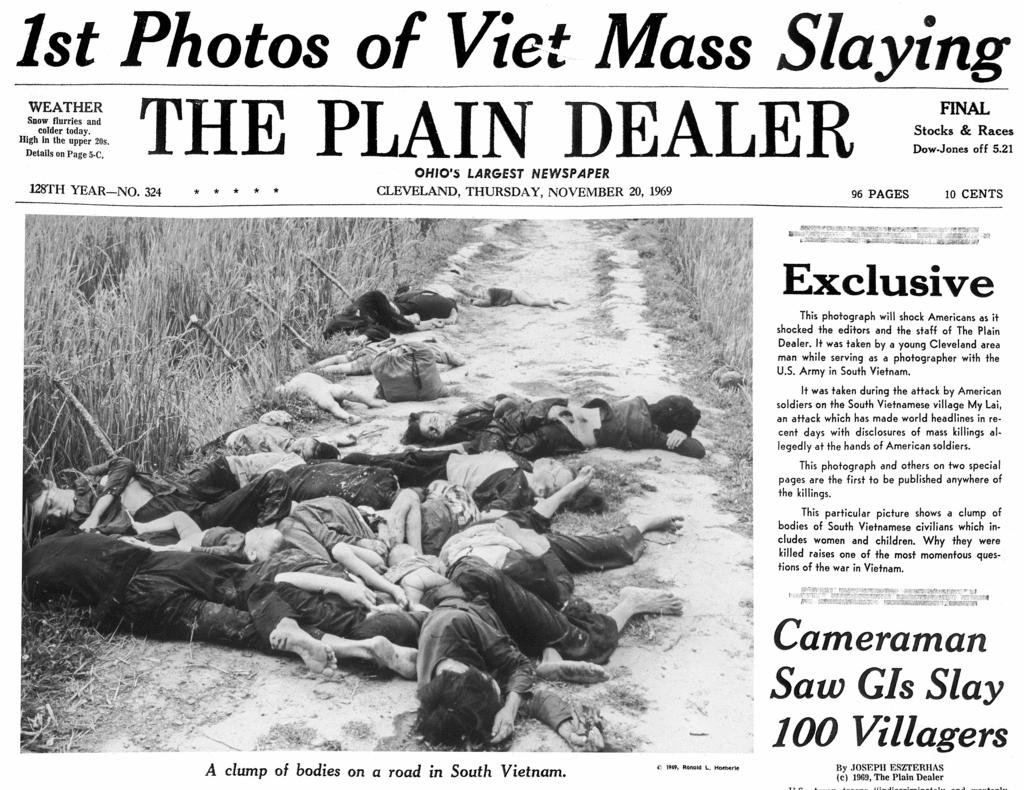
One thing the story lacked was photos. Without dramatic pictures, the facts of the massacre did not seem to register with the public. But as it turned out, there were photos. They were in the possession of former sergeant Ronald Haeberle, the army combat photographer who had been at My Lai during the massacre. Haeberle had had his official army camera with him that day, but he’d also had his personal camera on a strap around his neck, and he had brought some of his own photos home with him. When he heard about the interest in My Lai, he approached his local newspaper, the Cleveland Plain Dealer. On November 20, 1969, the paper published the first photos of the massacre.
The photos were gruesome, but what was most troubling was that they clearly showed the bodies of Vietnamese civilians—lots of them, jumbled atop and beside one another—but no enemy soldiers. Suddenly Time, Life, and Newsweek were all interested, and the story became a certified big deal. The December 5, 1969, issue of Life, for example, featured an extensive display of Haeberle’s photos, plus a story by Joe Eszterhas, a young reporter for the Plain Dealer.
Next, television joined the pack, offering dramatic interviews with members of C Company. One former soldier went on television to confess his role in My Lai and to say he was sorry. His mother blamed the army. She looked into the camera and declared, “I sent them a good boy, and they made him a murderer.”
In the following months, as the Calley court-martial unfolded, the My Lai case kept the issue of atrocities on the public agenda. Some in the military and their supporters in the media tried to downplay the charges, or to chalk the incident up to the “war-is-hell” philosophy. But the vast majority of editorial commentary was critical, blaming the army and raising new questions about the nature of the war in Vietnam. Coming after the coverage of the Tet Offensive the previous year, the My Lai story was another hammer blow against American enthusiasm for the war.
The My Lai story not only caused a sensation but also broke a journalistic taboo. In almost all previous wars, it was unheard of for any country’s press to report on its own side’s atrocities, especially while the fighting was still going on. Reader’s Digest, for example, offered Americans a steady drumbeat of stories about atrocities blamed on communists in Vietnam but never found a single case among U.S. troops. My Lai changed that, too.
Suddenly, there were stories appearing everywhere in the media about U.S. atrocities in Vietnam—rape, murder, torture, and a particularly shocking form of execution: pushing a prisoner out of a helicopter. There were stories that some American soldiers made a practice of cutting the ears off dead VC soldiers, drying them, and stringing them into ghoulish necklaces. In July 1970, Americans learned about the notorious “tiger cages,” a brutal prison maintained by South Vietnamese authorities on an off- shore island. When a congressional delegation visited, a young aide took photos, which were promptly published in Life magazine.
]]>0profdaly<![CDATA[The journalism battle fought on D-Day between Hemingway and Gellhorn]]>http://journalismprofessor.com/?p=44092024-06-05T01:33:54Z2024-06-05T01:33:54ZContinue reading →]]>D-DAY: Hemingway and Gellhorn at War By Christopher B. Daly
. . . In 1944, as the world war reached a crescendo, so did the marital conflict between Ernest Hemingway and his third wife, the journalist Martha Gellhorn. “Marty” was engaged in covering the Allied campaign to liberate Italy, but she still wanted to find some role for Hemingway. She even suggested that he might pitch a series to Collier’s, the popular national weekly magazine. If it worked, she knew full well that he would outrank her among the magazine’s correspondents; she also knew that each magazine got only one slot to cover the front lines, so it might cost her. Still, Hemingway balked and stayed in Havana – drinking to the point where he often started with a scotch around 10 a.m. and ended the night by sleeping in his clothes, on the floor. “My crime really,” Marty concluded, “was to have been at war when he had not.”
There are differing versions of exactly what happened next. One view is that Marty offered Hem the chance to take her place as Collier’s front-line war reporter. The other version is that he went around her back to editors at Collier’s and talked them into letting him big-foot her off the momentous story. From her letters it appears that Marty regretted the switch, and she certainly came to resent Hem for it. To make matter worse, she called in a favor with her writer friend Roald Dahl to arrange for the RAF to fly both herself and Hem across the Atlantic. As it turns out, Hem got his seat all right, and then he informed Marty that the RAF was not taking any women on such dangerous flights (even though the actress Gertrude Lawrence was somehow given a seat on Hem’s flight). Bumped from flying, Marty had to go by ship. She was the only woman and the only civilian on a Norwegian freighter full of explosives crossing the North Atlantic. As such, her ship was a prime target for Nazi submarines prowling the ocean.
At this point, the marriage was pretty nearly shot. During the long voyage, Marty poured her heart out in a letter to an old friend.
He is a good man, which is vitally important. He is however bad for me, sadly enough, or maybe wrong for me is the word; and I am wrong for him. . . . As far as I am concerned it is all over, it will never work between us again. There may be miracles but I doubt it, I have never believed in them. . . . I dread the time ahead, the amputating time, I do not see how to manage it.
Hemingway arrived in London well ahead of Marty in that fateful spring of 1944, and he was soon up to his old tricks. Thanks to the writer Irwin Shaw, Hem was introduced to Mary Welsh, an attractive American journalist (who also happened to be somewhat married). They were soon carousing around London, as Hemingway enjoyed getting to know the 36-year-old Mary, who clearly adored him. (As Mary wrote: “I wanted him to be the Master, to be stronger and cleverer than I; to remember constantly how big he was and how small I was.”) On May 25, while Gellhorn was still at sea, Hemingway attended a very boozy party in London hosted by the photographer Robert Capa. Hem got a ride home, but the driver crashed the car into a water tower, and Hemingway was thrown against the windshield, resulting in another of his many traumatic brain injuries. Among his hospital visitors was Mary Welsh of TIME magazine, who brought daffodils.
When Marty arrived in London, she quickly sized up the situation and decided she had really had it with Hem’s drinking, his lying, his cheating, and his bullying. She would have demanded a divorce right then, but she felt bad for the fifty-seven stitches etched into Hem’s head and so she waited.
All that spring, the Allies were planning their big push from England into France. All of London, indeed all of England, was abuzz about the impending invasion, the largest amphibious assault in world history. Everyone knew it was imminent, but no one knew exactly when or where. The details were top secret. Throughout May and early June, soldiers, officers, journalists, and others all knew that something epic was coming, but much still depended on the tides and the weather. In the final days, journalists were quietly tapped by military handlers and vanished, one by one, into the staging areas.
The Allied public relations staff assigned Hem to cross the Channel on a big Navy ship named the Dorothea Dix; from there he would be lowered into a landing craft skippered by Lieutenant (j.g.) Robert Anderson of Roanoke, Virginia.
In the story that he wrote for Collier’s, Hemingway behaves (and writes) as if he outranks Anderson – offering to steer the ship and, if needed, command the whole invasion. As usual, Hem makes himself the main protagonist of his story, if not the hero. Mostly, they end up bobbing around in their landing craft, searching for the intended landing spot.
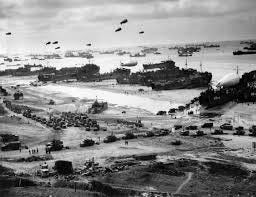
The landing craft, also known as Higgins boats, were 36 feet long, with sides made of plywood, equipped with an engine in the rear and a bow that could drop open to form a ramp. The boats could be driven into shallow water or right onto a beach. They could be used to sweep for mines, to transport vehicles and explosives, or to carry loads of soldiers. The U.S. Navy purchased thousands of them and used them to storm beaches from Normandy to Sicily to Iwo Jima.
Each boat could carry about three dozen soldiers who, with the bow lowered, could charge down the ramp and into action. Ideally, the men could exit swiftly, the skipper could throw it into reverse, and clear the area for the next craft to hit the beach. In practice, the boats tended to bounce around badly in choppy seas or high surf, and the wooden sides could not stop enemy fire. As a result, the soldiers on board were vulnerable. Many times, the ship’s bottom would be shin-deep with a mix of seawater, blood, and vomit.
This photo captioned “Into the Jaws of Death,” taken on D-Day by U.S. Coast Guard photographer Robert F. Sargent, provides the soldier’s view of the invasion from a Higgins boat.
In Hemingway’s account, we see him using his own binoculars, conferring with the skipper like a peer, offering advice to Anderson, pointing out landmarks, and trying to guide the boat to a section of Omaha Beach code-named Fox Green. Thousands of words later, the landing craft proceeds near the beach and disgorges its platoon of fighting men. Hem, who stayed on board, wrote a deeply misleading finale to his story. He notes that the Germans kept firing their antitank guns and mortars from the cliffs above the beach. But the Americans kept coming. “It had been a frontal assault in broad daylight, against a mined beach defended by all the obstacles military ingenuity could devise,” he wrote in his final paragraph. “But every boat . . . had landed her troops and cargo. No boat was lost through bad seamanship. All that were lost were lost by enemy action. And we had taken the beach.”
U.S. troops struggle to get ashore during the invasion of Normandy on D-Day, June 6, 1944.
Photo by Robert Capa for LIFE magazine.
When Hemingway wrote that “we” had taken the beach, he could not have meant that he was among the successful invaders, because he knew damn well that he had never left the boat nor gone ashore. To be fair, though, it was a common practice among U.S. journalists during World War II to say that “we” were doing this or that. So close was the identification of the press corps with the military corps, and so unified was the commitment to victory, that the usage became standard and drew almost no notice. But Hemingway’s last statement – “We had taken the beach” – was both true and misleading. It’s true that American troops had taken the beach, but by using the pronoun “we,” Hem was implying that he was among the “we” who had taken the beach. Actually, in this case they took the beach. In fact, Hem did not step foot on an invasion beach that day or any other. He made it back to London the same day and spent the night at the Dorchester Hotel in Mayfair. He did not get to France until weeks later, safe and dry. Then, thanks to the general he was attached to, Hemingway was provided with a captured German motorcycle that had a sidecar, plus a Mercedes convertible with his own driver.
As for Gellhorn, she was furious at Hemingway, enraged by his boorishness. As any journalist knows, the decent thing for him to have done would have been to find another magazine to write about D-Day for and to have left Gellhorn as the top correspondent at Collier’s. But no. He had to take her slot, then stash her at sea for three weeks while he partied in London and started romancing a new woman.
Marty was also angry at the last-minute restrictions imposed by the Allied public relations command. They decreed that no women would be allowed to report on the first day of the invasion. Instead, all the women reporters were shepherded into a giant press briefing center in London, along with any male reporters who were left behind; they were all locked in, and all fed the same official information about the invasion from Public Relations Officers.
As soon as the doors opened, Marty made her own way to the story. Wearing her standard-issue correspondent’s uniform, she hitched a ride to one of the embarkation ports in southern England. There, she wrote a story on June 6 about the first batches of German prisoners to reach England.
The next day, she found a hospital ship getting ready to cross the Channel to the invasion beaches. She talked her way on board, then locked herself in an empty bathroom and hid there until the ship was under way. Painted white, the ship was under the command of the English merchant marine, not the U.S. Navy, so she was allowed to move about freely, observe the action, and interview nurses, doctors, patients, and prisoners.
The result was a magnificent piece of reporting. She began by noting that the white medical ship stood out in the sea of grey military craft “like a sitting pigeon” and that “there was not so much as a pistol on board in the way of armament.” Carefully, the ship picked a way through lanes in the sea that had been cleared of German mines. “Then we saw the coast of France and suddenly we were in the midst of the armada of the invasion.” Noting the stunning number of ships, planes, and barrage balloons (“looking like comic toy elephants”), Gellhorn described the continuing booming of naval weapons all around.
Then, the first of the wounded began to arrive. A wooden box, “looking like a lidless coffin,” was lowered overboard to pick up the wounded from the smaller craft known as “water ambulances.” Those little ships were beginning to scour the surf and the beaches for wounded combatants to bring them to the large floating hospital. As it turned out, the first soldier was German. No matter. The medical team went right to work. Marty described horrible injuries suffered by U.S. soldiers – gaping untreated wounds, shattered bones, missing body parts.
Around sunset, she went ashore at “Easy Red” beach with a medical team and set to work as a stretcher-bearer. She was now the only woman among the invading force of hundreds of thousands of men. Staying in the narrow, marked lanes that had been cleared of mines, Gellhorn pitched in and helped move bodies in the dark to pickup spots. All the while, German sniper fire and the occasional anti-aircraft battery kept up the roar of war. “Everyone agreed that the beach was a stinker and it would be a great pleasure to get the hell out of here sometime,” she wrote.
Eventually, she boarded a landing craft loaded with wounded that was heading back out to the hospital ship, anchored in deeper water. She looked back at the beach, where bonfires were roaring. “The beach, in this light, looked empty of human life, cluttered with dark square shapes of tanks and trucks and jeeps and ammunition boxes and all the motley equipment of war. It looked like a vast uncanny black-and-red flaring salvage dump, whereas once upon a time people actually went swimming here for pleasure.”
Under fire, she had gone ashore and served as an eye-witness to history from one of the invasion beaches – something her famous husband had not done. Marty had beaten Hem to France.
Six months later, they were divorced. . . .
Christopher B. Daly is a journalist, historian, educator, and award-winning author. This story is adapted from his current work-in-progress, a book titled The Democratic Art, (UMass Press 2025) which is a narrative history of the role played by journalism in the careers of America’s top literary and visual artists.
[All quotations in this article come from Hemingway’s story “Voyage to Victory,” which can be found in By-Line: Ernest Hemingway, or from Gellhorn’s story “The First Hospital Ship,” which can be found in The Face of War.]
]]>0profdaly<![CDATA[A woman making history (and writing it too)]]>http://journalismprofessor.com/?p=44152024-03-21T00:47:16Z2024-03-21T00:47:16ZContinue reading →]]>Margaret Fuller pioneered the role of war correspondent in the 1840s.
Here’s an excerpt from my forthcoming book, The Democratic Art: the Role of Journalism in the Rise of American Culture. In honor of women’s history month, here is a history-making woman journalist.
. . . Finally, in early spring of 1847, Fuller and the Springs headed southward across France and down the Italian peninsula, then a hodge-podge of separate states. On arrival, Fuller felt an instant and deep connection to Italy, the home of Virgil and Dante, of Michael Angelo and Titian. As she wrote to Emerson at this time, “Had I only come ten years earlier! Now my life must be a failure, so much strength has been wasted on abstractions, which only came because I grew not in the right soil.” As her letter indicated, she felt that she had now found her real work – and perhaps her real self – in Italy. Indeed, as a writer, she was at her best. She gave up all plans to travel elsewhere. She was, in a sense, home. She had also found her true calling. “Margaret had become a journalist,” biographer Megan Marshall concluded, “whose trademark was experiencing reality firsthand and recording the truth as she saw it.” Fuller’s love for Italy soared when she finally reached Rome, the Eternal City she had read so much about. For the rest of her stay abroad, she would report only from Italy, sending Horace Greeley, the publisher of the biggest newspaper in the U.S., some two dozen dispatches between May 1847 and January 1850.
As Easter approached in the spring of 1847, Fuller and the Springs made their way to the epicenter of the Roman Catholic religion on April 1, Maundy Thursday, to attend the evening Vespers service at St. Peter’s. Afterward, they slipped into a huge throng of pilgrims in the streets around the Basilica. Somehow, Fuller got separated from the Springs and found herself alone in the jostling crowd. Suddenly, a handsome young Roman appeared and offered his arm to Margaret. Although he spoke no English, he managed to indicate that he was concerned for her safety and was offering his help. Using her Italian, Margaret accepted his offer, which she would later call a “singular, fateful” moment. Thus, Margaret Fuller, 36, an American Protestant, met Giovanni Angelo Ossoli, 26, an Italian Catholic. Soon, she would learn that Giovanni was something of an aristocrat. He came from a noble Italian family, but since he was not the oldest son, he did not stand to inherit the either the family’s wealth or property. Nevertheless, he was formally a Marquis – penniless, to be sure, but titled.
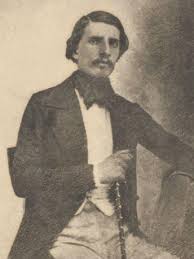
Giovanni Angelo Ossoli
For the time being, Fuller wrote little about Ossoli for public consumption, and even in her letters to friends, she was rather evasive. In late spring, she traveled with the Springs as far as Venice. From there, the Springs headed north to visit Germany before heading back to America. Fuller decided to stay in Italy, having to make do without the Springs’ generosity; a single woman, she now had to fend for herself. She headed next to Florence, (which she found “too busy . . . more in its spirit like Boston, than like an Italian city”) and then to Milan. Broke, she wrote to Greeley, asking him for $600 for living expenses. Originally, the Tribune editor had advanced her $120 for 15 columns; she assumed, mistakenly, that that was all he wanted or would pay for. He wrote her immediately to correct her, saying “All the letters you see fit to send us at $10 each will be more than welcome.”[i] Fuller extended her travels that early fall of 1847 to take in the lakes at the top of Italy and the bottom of the Alps. Having traveled the Great Lakes back home, she had to admit that they could not compare with the Italian lakes.
In early October, she returned to Rome, and Giovanni helped her find an apartment on the busy Via del Corso, not far from the Piazza Popolo and the Borghese Gardens. For Fuller, this was something of an idyll, and it appears that she fell deeply in love with Ossoli. But could she marry him? She could not resolve her feelings about marriage, which she considered a “corrupt social contract.” At the same time, she was drawn to Ossoli and may have been considering giving up her virginity. She had known several great men and declined them all. Ossoli, however, presented her with another kind of man: simple, kind, loving. Besides, he wanted to marry her. Fuller wrote to her mother at this time: “My life in Rome is thus far all I had hoped. I have not been so well since I was a child, nor as happy ever as during the last six weeks.”[ii] All the evidence suggests that sometime in early December, Fuller overcame her doubts, and the couple engaged in intercourse. Margaret was thirty-seven and a virgin when it came to sex with men; Giovanni was ten years younger and probably not a virgin. She was a Protestant; he was a Catholic. They faced almost insurmountable obstacles to marriage, especially a public one, since Italy forbade such “mixed marriages.” The couple were sure that the Ossolis would reject them; they assumed that her family and friends would frown too. So they kept mum.
Immediately, Fuller’s dispatches showed a freshness and liveliness – probably a mixture of her newfound joy in her private life and a rising optimism about the republican movements growing across Europe. A landmark new history of the revolutions of 1848 praises Fuller for “the most evocative and insightful eyewitness accounts of Roman events.”[iii] In a column she finished in December, Fuller described three “types” of America visitors to Europe, then turned to continental politics. After 1800 years of Christianity, she asks, what does Europe have to show for it? “Where is the genuine Democracy to which the rights of all men are holy?” The dispatch goes on to point out the widespread misery in Europe and the refusal of the dictatorial monarchs to address the people’s needs. Increasingly, she points to “associationism” as the radical remedy for industrial poverty – without going into great detail. Evidently, Fuller assumed that readers were familiar with associationism, the social theory put forth by Charles Fourier and embraced by Greeley that called for workers to jointly own the factories and workshops where they toiled. In the same column, Fuller turns to the recent U.S. war with Mexico, which threatened to expand slavery into a vast new territory. “I listen to the same arguments against the emancipation of Italy, that are used against the emancipation of our blacks; the same arguments in favor of the spoliation of Poland as for the conquest of Mexico.” On a hopeful note (yet with an ominous undertone), she added that perhaps the younger generation could make a better world. “I have witnessed many shipwrecks,” she added, “yet still beat noble hearts.”
Soon, though, Fuller began suffering symptoms that added up to morning sickness. It is not known if she even contemplated an abortion, but it would have been virtually impossible to obtain one in Italy. Her status as an unwed mother brought with it another raft of problems. If the baby were born out of wedlock, it could be considered a “foundling” in Italy and snatched away from her. Should they marry? Should they wait and see if the baby lived? While Margaret was facing such problems, her finances remained precarious. Nevertheless, Fuller persisted. Indeed, in the coming months, she would prove herself as a successful foreign correspondent and as a terrifically resourceful woman – a single mother, supporting herself financially through her professional work and witnessing a violent revolution. It is fair to say that the privileged ladies of her Conversations back in Boston and the young Harvard-trained ministers she knew at home would be astounded to see her in Rome.
As the year 1848 began, Fuller remained engaged in her work – covering Europe for the largest-circulating newspaper in America. With Greeley’s support, she was well positioned to cover the growing discontent across the continent and the rising calls for democracy and social reform. Revolution was in the air, as insurgent leaders rose up to protest the devastating new impacts of industrialization and the infuriating old insults of autocracy. Greeley had other correspondents in Europe, all men, but none wrote as often, or as well, as Fuller. As the demands for change grew – led by radicals like Mazzini and Mickiewicz – Fuller did her best to cover the great developing story. Broke again, she was stranded in Rome because it was becoming too dangerous to travel and cross contested borders. By now, she was collecting material for a work of history that would capture the great events of 1848.[iv]
Still, she needed to keep working as a journalist. To overcome the many handicaps, she pioneered an array of techniques that would be used by generations of foreign correspondents to come. She kept up with developments by reading the European press – after all, she could read not only English but German, French, and Italian as well. She also interviewed visitors as they passed through Italy, bringing her insights from Vienna to London. And, she cultivated sources close at hand among the American officials posted in Rome, especially the U.S. diplomat Lewis Cass Jr.. In addition, she roamed on foot around Rome, making conversation with Romans from all walks of life. Fuller also had to another issue familiar to all foreign correspondents – staying in contact with the home office. In the late 1840s, telegraph service was becoming established, but it would be two more decades before a reliable telegraphic connection spanned the Atlantic Ocean. So, Fuller had to be sure to get her handwritten dispatches to an ocean-going steamship, which could take it to Boston or New York. To send a message to Greeley and get an answer could take two months.
While restricted in her movements, Fuller read widely among European newspapers, so she was hardly cut off from the wider world. And, as it happened, the momentous events of 1848 would bring one great revolutionary movement right to her doorstep – that was the uprising against papal rule over Italy. In one dispatch early in 1848, Fuller denounced the conservative influence of the Catholic priesthood and the Jesuits in particular. She believed that they were scheming to maintain their traditional powers and prerogatives in Italy and other Catholic countries. “How any one can remain a Catholic . . . after seeing Catholicism here in Italy I cannot conceive,” she wrote in Dispatch No. 22. This column, as well as others, antagonized the growing number of Catholic readers of the Tribune in America, especially Bishop Hughes of New York, who denounced Fuller in print and damned the rebels for imposing “a reign of terror over the Roman people.”
Around the end of her first trimester in late March, Fuller bemoaned the chilly rain and her recent ill health. “Now this long dark dream – to me the most idle and most suffering season of my life – seems past,” she confided to her readers, while keeping her pregnancy secret, of course. She then pivoted to a roundup of news from that revolutionary season: rebellions in Sicily and Naples, the dethronement of King Louis Phillipe in France, the forced resignation of Metternich in Austria, the uprising in Venice, and more. “With indescribable raptures these news were received in Rome,” prompting dancing in the streets. In a postscript dated April 1, Fuller mentioned that she took a brief trip outside Rome. While she was away, one of the last holdouts of Hapsburg rule capitulated in Verona. It now appeared that Mazzini’s dream was becoming real. “Returning to Rome, I find the news . . . that Italy is free, independent, and One.”[v]
A few days later, more good news. In April, she received a letter from Greeley in which she learned of a major subsidy from the publisher, who confided that he had had to sell part of his stake in the Tribune to raise the funds to keep her on the newspaper’s payroll. Now, the air was not only clear between herself and her lifeline, but she could also look forward to an easing of her pinched circumstances. That same month, she wrote a column expressing again her disappointment in Pope Pius IX, saying he had betrayed the cause of Italian unification, which he had supported the previous year. Now, the pope was urging Catholics across Europe to submit to “their respective sovereigns.” Near the end of that column, she added a fresh denunciation of the U.S. conquest of Mexico, which she saw as another sad episode of one nation robbing another one of its right to self-determination. Turning to Europe, she added: “Here things are before my eyes worth recording, and if I cannot help this work, I would gladly be its historian.” [vi]
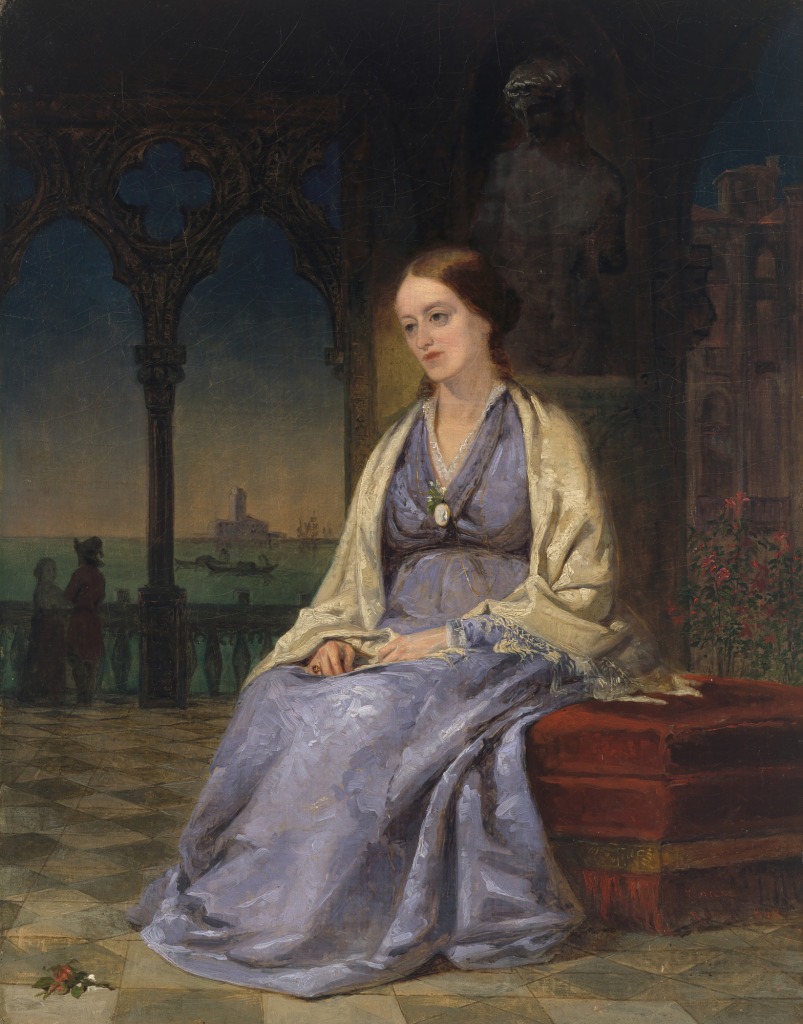
Portrait of Fuller by Thomas Hicks, from life, May 1848. U.S. National Portrait Gallery.
Around this time, despite the news of political upheaval across Europe, Fuller made plans to go into seclusion in L’Aquila, a small town in the mountainous Abruzzi region. She felt she had to stay away from the popular summer resort towns to avoid running into any Americans or Britons who might recognize her and spot her growing pregnancy. Emerson wrote to her that month, urging Fuller to return to America with him, but she replied evasively, trying to throw him off the scent: “I have much to do and learn in Europe yet,” she wrote. “I am deeply interested in this public drama, and wish to see it played out. Methinks I have my part therein, either as actor or historian.”[vii]
The radical part of the campaign to re-unify Italy, the Risorgimento, echoed certain themes from the American Revolution. One goal was to rid Italy of royal rule from outside the territory, just as the Americans had thrown off rule by the king of England, and unify the newly independent states into a territorial federation. That goal would involve winning independence from France, Spain, Austria, and others – all at the same time. Some who supported that goal were willing to replace outside rule with a home-grown royal family under a new King of Italy. The other faction had a more radical agenda. This group, which included Mazzini, wanted a new democratic republic, where the Italian people would govern themselves. Like Thomas Paine in 1776, they wanted to rid Italy of all rule from above, including the Pope. The new republic they envisioned would be a secular one, even in an overwhelmingly Catholic country. In the 1840s, this was indeed a radical agenda, and Fuller embraced it passionately and publicly.[1]
Meanwhile, Fuller remained at work on her history project. She continued gathering material: notes, pamphlets, newspapers, and letters she exchanged with friends across Europe. Of course, her own dispatches for Greeley were part of the process; those columns were what a later journalist would refer to as “the first rough draft of history.”[viii] As two Fuller scholars have noted: “The relationship she envisioned between the dispatches and her “History” was that between sketches and an oil painting; the first done quickly and impressionistically with the scene before her eyes; the second created in the studio and showing the effects not only of contemplation and reflection, but also of selection and arrangement.”[ix] This approach describes much the same technique that Winslow Homer would use a decade later in covering the U.S. Civil War as a sketch artist for a weekly news magazine before turning certain of his “first draft” images into masterpieces of oil painting.
Fuller arrived in L’Aquila on May 29. Later, she would tell Tribune readers of this period: “I have been away . . . during the Summer months, in the quiet valleys, on the lonely mountains.” In the heat and isolation, it was indeed lonely for the American fugitive. What’s more, Fuller was missing the landmark gathering of feminists that took place in late July at Seneca Falls, New York. Led by Susan B. Anthony, Elizabeth Cady Stanton, and Lucretia Mott, the gathering marked a bold and concrete step toward addressing many of the issues Fuller had raised in her foundational book Woman in the Nineteenth Century. Fuller herself would have to settle for reading about the Seneca Falls convention and its “Declaration of Sentiments,” many weeks later, when she caught up with copies of the Tribune.
At the same time, she found a reason to relocate again. L’Aquila was in the territory of the conservative King of Sicily, and he had started arresting republicans. Fuller could not be sure that her American citizenship would protect her, so she moved out of his territory, to the town of Rieti, which was then part of the Papal States. The move placed her closer to Rome as well, and now Ossoli could visit her. One biographer believes that Margaret and Giovanni quietly married during this period, if only because it would make life much simpler for them as a family, especially when it came to crossing Italy’s many borders.[x] Still, Ossoli had his duties in the Civic Guard, so he could not stay long. Fuller stayed in Rieti and kept working on her history, but it was a difficult time. As her pregnancy advanced, she had no companions or friends to help her. “I feel lonely, imprisoned, too unhappy,” she lamented to Ossoli.
Then, on September 5, while Ossoli was with her in Rieti, Margaret Fuller gave birth, at age 38. They named the baby Angelino Eugene Philip Ossoli and they started calling him “Nino,” a common Italian nickname Together, the new family enjoyed a happy interval, though brief. Giovanni insisted that the boy have the Catholic sacrament of baptism, but that would require waiting 40 days in Rieti. Married or not, Fuller could not wait that long; she needed to get back to work, and she wanted to keep the baby secret for at least a while longer. So, she arranged for Nino to be cared for in Rieti by a wetnurse. Then, she headed back to Rome. By mid-November, 1848, she was back at work. Still, around Christmas she made a trip to Rieti to see Nino, who “seems to be well,” although, as she wrote somewhat ominously to Giovanni, “not much bigger than when I left him.”
Nearing forty, she was managing as a virtual single mother, covering a story of historical importance. “Now, a new hard-hitting tone found its way into her correspondence,” according to one analysis. “She was a different woman by the time she returned to Rome – more militant, more Italian, more certain than ever that her hopes were bound up with the fate of the revolutionary cause in Europe.”[xi] Her dispatches about the tumultuous year just ending were having an impact. She was having the kind of career a few American women journalists (among them, Martha Gellhorn, Lee Miller, and Christiane Amanpour) would follow in the coming centuries. Among Fuller’s many readers back in the United States was Walt Whitman, now approaching thirty, working as a journalist. Later, he would reflect on the hopes he felt were raised by 1848, calling the uprisings: “That brief, tight, glorious grip / Upon the throats of kings.”[xii]
At year’s end, Fuller dashed off two dispatches to the Tribune. She wrote that when she had seen the first signs of snow in the mountains, she had returned to Rome. “I left what was most precious that I could not take with me,” she told her readers, in a veiled reference to her infant boy; Nino, she believed, was safe in the countryside. Because of the growing tension around whether the young Roman Republic would long survive, Rome was now “empty of foreigners.” As a result, rents were plunging, and she could afford a sunny and spacious room at 60 Piazza Barberini (now marked by a wall plaque), from which she could see the magnificent Barberini Palace, home of popes. In her column, she noted the election of the new Whig president Zachary Taylor at home and urged him to send a “good ambassador” to Rome. “Another century, and I might ask to be made Ambassador myself . . . but woman’s day has not come yet.”[xiii]
While still bracing for a counter-strike, Fuller told her readers about the official proclamation of the Roman Republic, on February 8, 1849. As a candid supporter of the new republic, she greeted it with admiration. She reported that she went into the streets and joined a procession heading to Rome’s magnificent Campodoglio. With banners flying, the new leaders mounted the steps to the high square and one read the manifesto aloud. It had four main provisions:
Popes shall have no role in government.
There will be freedom of religion.
The new Roman Republic shall be “a pure Democracy.”
The Roman Republic will join the new nation of Italy.
In this dispatch, Fuller was already expressing fear of a French intervention to roll back the republican victory. Louis-Napoleon Bonaparte was the new president of France, and, while he was an elected public servant, Fuller believed that in his heart, he was a monarchist. Fearing an attack, she pleaded for American support for the fledgling Roman Republic.
In a dispatch written on March 20, she opened with this lead sentence: “The Roman Republic moves on better than could have been expected.” This is typical of her evolving literary style. Her opening sentences (what journalists would call her leads, or “ledes”) went right to the heart of the matter, introducing the general topic, establishing a mood or tone, and advancing the story without giving it all away. In the same dispatch, she praised her dear friend Mazzini – now the de facto head of state of the Roman Republic – as “the idol of the people” and “a man of genius.” She also managed to slip away again to Rieti and spent nearly two months with Nino before returning to Rome, a city on the brink of crisis.
On April 25, 1849, the blow she feared fell. French forces landed at Civita Vecchia, a port city 37 miles northwest that had served Rome for centuries. Fuller wrote about the early stages of the invasion in a dispatch she finished on May 6. Her lead was another gem:
I write you from barricaded Rome. The Mother of Nations is now at bay against them all.[xiv]
The French forces were led by Generale Nicolas Charles Victor Oudinot, who proved be a cruel and pompous scoundrel. He claimed that he was coming as a friend, to restore “order” to the Papal States, a French ally. Fuller saw right through him. “No one was, no one could be, deceived as to the scope of this expedition,” she warned Tribune readers. “It was intended to restore the Pope to the temporal sovereignty, from which the People, by use of suffrage, had deposed him.” In his pursuit of order, Oudinot marched on Rome and proceeded to bombard it with cannon fire, inevitably causing a fair amount of disorder. In the early stages of the siege of Rome, Fuller publicly criticized the American charge d’affaires, Lewis Cass Jr., for continuing the policy of not officially recognizing the new Roman Republic. How, she demanded, could the United States not salute a fellow republic?
While continuing to write for Greeley, Fuller became more and more committed to the republican cause. Giovanni was stationed with his Civic Guard unit in the Vatican gardens, and she visited him there when she could. On April 30, at the invitation of an acquaintance, the Princess Belgioioso, Fuller became the director of the Fate Bene Fratelli hospital on Tiber Island, where she organized the nurses and tended the wounded herself (as Whitman would do in the U.S. Civil War). “I have, for the first time, seen what wounded men suffer,” she wrote in a dispatch in late May. Fuller was also fretting about Nino, who she believed was at least safe in Rieti. As the French drew near the city, she worried more and more about Giovanni, whose regiment was coming under fire. She was now, according to her biographer, the last American journalist remaining in Rome. After more than a month of battles, the French arrived at the gates of Rome in early June and began shelling the city.
Fate Bene Fratelli Hospital.
Now, for the first time, Fuller endured the multiple terrors of being part of a civilian population under bombardment. French cannons hurled bombs into the midst of the urban population by day and night. “War near at hand seems to me even more dreadful than I had fancied it.”[xv] On Sunday, June 3, the French assaulted the barricades surrounding the city. “The attack began before sunrise and lasted all day. I saw it from my window,” Fuller reported, adding: “The Italians fought like lions.” On June 10, she finished a somber dispatch, opening with a question lede:
What shall I write of Rome in these sad but glorious days? Plain facts are the best; for my feelings I could not find fit words.
For the time being, the French were content to stand off and shell the city into submission, inflicting casualties among civilians as well as among the new recruits and volunteers of the young Republic. Fuller noted the “frightful sacrifices” made across the city, including the reduction of the famed Villa Borghese to rubble. Her hero Mazzini was standing “firm as a rock,” she claimed, then asked: “Yet how long, O Lord, shall the few trample on the many?”[xvi]
On June 21, three weeks into the siege, she filed another dispatch. (Although filled with fresh news, the logistics of trans-Atlantic communication meant that it would not be printed and read in New York for more than a month.) The French bombardment was taking its toll. More and more often, the French bombs would open hole in the city’s defenses, and the Roman militia would rush to the spot, rebuild the barricades, and fire back. Fuller reported the story of one woman in the Trastevere district who saw one of the French bombs land near her. The bomb had a lit fuse, but the woman bravely picked it up and extinguished the fuse before it could cause mayhem. Fuller wrote that her example caught on quickly, and Romans learned to put out the fuses. They gathered the unexploded cannon balls and hauled them to the Roman forces to use against the French.
Fuller was also working almost every day at the hospital, seeing for herself the grisly toll of the bombardment on the bodies of republican soldiers, many of them young students from across Italy who had rallied to Rome’s cause. Many endured gruesome amputations. “One kissed an arm which was cut off,” Fuller reported. She described another soldier who collected the pieces of his own bones being extracted from his wounds, to save as relics. “I suffer to see these temples of the soul thus broken . . . but I would not, for much, have missed seeing it at all,” Fuller wrote in what could be a motto of all war correspondents – from Herodotus to Martha Gellhorn to reporters unborn. They all seem to know or say: war is horrible, but I had to bear witness. In another trope of war reporting that would become a classic, Fuller also reported that the bombs had a terrible beauty. “In the evening ‘tis pretty, though a terror, to see the bombs, fiery meteors, springing from the horizon line upon their bright path to do their wicked message.”
On the night of June 21-22, the bombing reached a crescendo around 2 a.m. “We were all alarmed by a tremendous cannonade. It was the moment when the breach was finally made by which the French entered. . . That was the fatal hour for the city,” Fuller reported in prose that she had now mastered – a vigorous style, using short sentences and active verbs. The result was writing that was vivid, specific, concrete. “Those who were brought into the Hospitals were generally grievously wounded, very commonly subjects for amputation. My heart bled daily more and more at these sights, and I could not feel much for myself, though now the balls and bombs began to fall round me also. The night of the 28th the effect was truly fearful, as they whizzed and burst near me.”[xvii]
In a day, the city became a vast camp of refugees, fugitives, and wounded. The press came under censorship; a curfew was imposed; and the Ossolis were wanted figures. She ventured out for one last survey of the ruin.
I entered the French ground, all hollowed and mapped like a honey-comb. A pair of skeleton legs protruded from the bank of one barricade; lower, a dog had scratched away its light covering from the body of a man, and discovered it lying face upward all dressed; the dog stood gazing on it with an air of stupid amazement.
Afterward, Margaret would no longer go out in public for fear of retribution. But in her latest dispatch, she offered a bold prediction: “The fruits of all this will be the same as elsewhere: temporary repression will sow the seeds of perpetual resistance.” She went swiftly to see the American diplomat Cass and prevailed on him to supply two fake American passports – one for Mazzini and one for Ossoli. On July 8, with more help from Cass, Fuller left Rome in a carriage and headed to Rieti for a reunion with her son. To her horror, she found Nino failing to thrive and near death. She discovered that the hired “wet nurse” had been ordered by her own husband to breastfeed only their child. Nino had been kept alive on a diet of bread soaked in wine. He had lost weight and became alcohol-dependent until his mother showed up, took him back, and supervised his care and feeding. With the help of a new nurse, Nino began to improve.
At the end of August, Fuller wrote a dispatch looking back over those “sad but glorious days” of the Republic. It began with this mournful lede: “To write from Italy is now become a sorrowful business.” (She wrote “Italy” rather than “Rome” because she was hiding out in Rieti.) She accused the French commander of sacking Rome and said his denials were flat lies. “They [French bombs] fell in the Vatican quarter; often on the Quirinal, on the Capital, on the Pincian. I am eye-witness that they did.” She went on to rebut another theme of French propaganda – that they occupied Rome to bring order. Before the occupation, Fuller had felt safe and free in republican Rome.
I, a woman, walked alone at all hours, in all quarters of Rome; I stood alone amid the throng of soldiers and of citizens; I took with me little girls to help me at the hospitals, and their parents thought my protection sufficient; I was at the gates, at the post office, in the nearer quarters of Trastevere, in the Vatican gardens – I never saw an act of violence, was never even jostled in the excitement of the crowd; I do not believe ever people or soldiery showed a finer spirit.
Notably, she could still write long sentences, but now they have energy and clarity. According to Reynolds and Smith, on this same day, Fuller wrote a letter to her mother, telling her that she had both a husband and a son and that they hoped to reach America in the summer.[xviii]
Fuller and Ossoli made their way to Florence, where they settled into a small apartment on the Piazza of Santa Maria Novella. Some speculate that this is when they quietly got married. Nino was gaining weight, and they often took him on strolls along the Arno or to museums. On November 15, she filed a dispatch from Florence, confiding to her readers that the defeat of the republic was hitting her hard.
I have begun to write, yet little do I feel inclined . . . I take long walks into the country, I gaze on the beauty of nature, and seek thus to strengthen myself . . . I look again upon art, and solace myself in its calm. . . .
To find out what happened to Margaret Fuller as she headed back to the United States in 1850 with her son and the boy’s father, the rest of the story will be told in my next book, The Demoratic Art.
[1] Rome in 1848 is the place and time chosen by Willa Cather (chapter 9) for the prologue to her novel Death Comes for the Archbishop, but Cather makes no mention of the political revolution and repression that Fuller saw.
[2] The leader, Garibaldi, departed on July 2 on horseback with four thousand men, trying to evade all the anti-democratic occupying forces in Italy. By August, all were dead, except for Garibaldi and one follower. Garibaldi went into exile in London and New York City. Ten years after fleeing Rome, he returned and achieved his ultimate goal – the unification of Italy. As for Mazzini, he escaped and made his way to England. He remained committed to the cause, but he later broke with Garibaldi over the issue of establishing a monarchy for the newly unified Italy (King Victor Emmanuel II). Mazzini held out for the twin goals of unification and democracy.
[i]More than welcome . . . Greeley’s letter is quoted in Dispatches, p 21.
[ii]Last six weeks . . . See Dispatches, fn p 167.
[iii]eyewitness accounts of Roman events.” Christopher Clark, Revolutionary Spring, (Crown, 2023) p 254.
[iv] For a penetrating history of the continent-wide upheavals, see Clark.
]]>0profdaly<![CDATA[America’s first Black newspaper]]>http://journalismprofessor.com/?p=43842024-03-15T21:21:20Z2024-03-15T21:21:20ZContinue reading →]]>March 16 marks the 197th anniversary of the founding of the first Black-owned newspaper in the United States, Freedom’s Journal.
During the 1820s, free Blacks in New York City and elsewhere were beginning to form a literate community large enough to support a newspaper. As it happened, during the very year that Frederick Douglass started to learn to read, the first newspaper in America owned by Blacks was founded. Freedom’s Journal began publishing on March 16, 1827 in New York City.
The founding editors were Reverend Samuel Cornish, a minister, and John Russwurm, an alumnus of Bowdoin College, who was the first black person to graduate from an American college.
In their first number, the editors boldly stated their goal:
“We wish to plead our own cause. Too long have others spoken for us.”
Not surprisingly, Freedom’s Journal was editorially opposed to slavery, and it published the first account of a lynching ever printed in the United States. At the same time, it served its largely Black readership by running newsy items of general interest, as well as sermons, poetry and advertisements.
The newspaper did not survive long, but it was followed by many others, notably Frederick Douglass’s first newspaper, The North Star, which he founded in 1847.
]]>2profdaly<![CDATA[“ALL RIGHTS FOR ALL!”]]>http://journalismprofessor.com/?p=43422024-02-09T15:31:15Z2024-02-09T15:31:15ZContinue reading →]]>ALL RIGHTS FOR ALL!
Antebellum Ideologies of Liberation
By Chris Daly / Boston University
March 25, 2022
INTRO
In this essay, I offer some HIGHLIGHTS from a new book I am working on, called The Democratic Art:. That book is an exploration of how, between the 1840s and the 1950s, the newsrooms of America served as ports of entry and incubators for many major figures in American literature and the visual arts.
I want to focus is on three bold figures who were active before the Civil War: Margaret Fuller, Walt Whitman, and Frederick Douglass. All three were successors to the Founding generation. All three were journalists. All three helped formulate a sweeping new agenda for social justice.
In brief, the Founders had engaged in a rights revolution that we might call “leveling down.” That is, among the goals articulated in their pamphlets, in the Declaration, and in the Constitution were some truly revolutionary changes to British society: no monarchy, no hereditary aristocracy, no primogeniture. We might think of that bundle of changes as “topping” the upper reaches of society. That is: rank, titles, and power would all be capped. The result (for propertied white males at least) would be a society whose upper ranks would be relatively broad and much less steep than the upper ranks of British society.
After the Revolution, however, it is important to note that the lower ranks of American society remained at least as unequal as those in Britain.
–Indentured servitude was widespread.
–Women and girls were treated as appurtenances of males.
–The population of enslaved chattel was subject to routine brutality.
So, while the American Revolution deserves its place in the history of liberating individuals and making society, as a whole, somewhat less unequal, much remained to be done.
Between 1845 and 1855, a cohort of loosely connected allies radically widened the agenda for freedoms. Freedoms that were personal, intimate, and innate. This trio of journalist-activists demanded nothing less than an end to sexism, homophobia, and racism.
Margaret Fuller, Walt Whitman, and Frederick Douglass emerged to me as heroes. In their writings, they all pointed the way to a fairer and freer world. Fuller battled sexism; Douglass battled racism; Whitman, in his way, battled homophobia. They raised their voices to promote the idea that each individual matters and that each individual has an equal right to self-determination. Like leaves of grass, none are taller, better, or more important. But also like leaves of grass, none are lesser, inferior, or unimportant.
In their time, Fuller, Douglass, and Whitman took republican democracy as a starting point and envisioned a leveling in an upward social direction – no more enslaved people, no more second-class citizens. All are one. All are not identical, but all are equal in worth and dignity.
FULLER
First, Fuller. Born in 1810, Margaret Fuller was the oldest child of Timothy Fuller, a prosperous lawyer and member of Congress representing Cambridge, Massachusetts. He poured all his talents and energy into educating Margaret, up to the point where the boys her age were preparing to enter Harvard and other colleges. But with no college in America accepting girls at the time, Margaret faced a closed door. She tried many stratagems to keep pace with the men her age – beginning with teaching.
After thinking about her own situation and ransacking the pages of classic and contemporary literature, Fuller put forth a bold agenda. In her 1845 book Woman in the Nineteenth Century, she took up the question her own life presented: why are women treated so poorly?
At the time, a paradox defined the status of most women. They were supposed to live up to two conflicting ideals.
On the one hand, women, especially middle- and upper-class women, were considered delicate flowers who needed to be sheltered from the filth and strife of activities like business, the military, and politics. They were expected to be virgins until marriage. After that, they were expected to become the center of the home, where they would provide moral uplift and basic education to a large number of children.
At the same time, women, especially working-class and poor women, were also considered beasts of burden who should cook, clean, wash, nurse, and meet the needs of others all the livelong day and well into the night. They were seen by men as sturdy, dirty, and flirty. In almost no case did men consider it worthwhile to educate girls; they were too often seen as ruled by feminine “sensibility” (emotions) and not by manly “sense” (reason).
Education would be wasted on girls. Even worse, it might leave them discontented with their lot in life.
In her Woman in the Nineteenth Century, Fuller raised key questions: Why should men exercise a power that amounts to legal conservatorship over women? Why should women be relegated to the status of children or mental defectives?
Fuller advanced two remarkable arguments. First, she argued, men and women are not opposites, and one sex is not superior to the other. Indeed, she said the evidence suggests that men and women are complementary and that the elements of the gender extremes are usually present in everyone, to varying degrees. Thus, she continued, most men are “womanly” to some extent, and most women are “manly” to some extent.
In other words, everyone is a mixed case of attributes. Since the sexes are not fixed at opposite poles, there is no basis for saying that one sex is suited only for certain activities — and therefore no basis for denying members of either sex the opportunity to find out what they are good at. Not everyone will be equally adept at all things, but we will never know if we don’t let individuals find out for themselves. Of course, it stands to reason, then, that girls should be educated alongside boys. Given a chance, she wrote, there was nothing that women could not do. In a famous formulation, she wrote: “Let them be sea-captains if they like!”
WHITMAN
Born in 1819 into a downwardly mobile family in Brooklyn, young Walt went to school for a couple of years, then began to learn the printer’s trade. Like many bright boys with nimble fingers, he started by learning to set type, working at New York City’s growing roster of newspapers, magazines, and book publishers.
Throughout much of the 1840s, while he was in his 20s, Whitman was composing his poetic masterpiece, Leaves of Grass, first published in 1855. During that drafting period, we know that he was reading Fuller and Douglass.
We also know that Walt Whitman loved men.[i] Of that there is no doubt. But almost every other aspect of Whitman’s sexual life is shrouded in mystery, red herrings, misconceptions, hints and rumors, claims and counter-claims, along with outright fabrications. We also know for sure that Whitman never married.
Of course, the text can be considered separate from the man. But I believe that when an author declares again and again that his main poetic purpose is to compose and sing songs of himself, then we cannot help but ask: OK, poet, just who are you anyway?
For Whitman, in matters of love and sex, the stakes were very high – both for his actions and for his words. During Whitman’s lifetime, it was illegal in New York state for a man to have sex with another man. Moreover, as Whitman well knew, a sizable portion of the population considered sexual acts between men repugnant. Indeed, the very terms “gay” and “homosexual” as we understand them were not part of the nineteenth century American consciousness or vocabulary. So, in trying to reveal himself as a man who loved men, Whitman had to be somewhat circumspect.
By his own accounts, he knew quite a few men intimately. In New York, he was a frequent rider of the horse-drawn omnibuses, even when he had no particular place to go, just so he could meet the drivers. He knew all the bus teamsters and spent a lot of time with them – “not only for comradeship, and sometimes affection.”
Looking back years later, Whitman added: “I suppose the critics will laugh heartily, but the influence of those Broadway omnibus jaunts and drivers and declamations and escapades undoubtedly entered into the gestation of Leaves of Grass.”
In his debut edition of Leaves of Grass in 1855, Whitman downplayed the homoerotic elements of his life and poetry. It was not until the 1860 edition that he dared to include the “Calamus” cluster of poems, which are replete with phallic imagery and passionate promises to one or more male lovers.
. . . The Whitman who remains most central to whatever has become of the “American experiment” is the poet who cruised the streets of New York, who skinny-dipped with rough trade, who caroused in pick-up bars and lowdown dives, who ministered to the bodies of young soldiers, who loafed with boys in the fields and backwoods of a perpetual frontier.
In the end, with such a sparse record about the sex life of such a complex character, there may be no simple answer to Whitman’s sexuality and its consequences. But I think that, as always, Whitman was himself pointing us to an answer.
Even considering the standards of literary decorum and good taste in the Victorian era, Leaves of Grass was quite daring about sex. Whitman was actually quite frank and even bold.
Throughout, he not only praises sexuality in general. He not only hails the bodies (and body parts) of both the male and the female. He also leaves behind flags and emblems telling readers that he himself is not only heterosexual, he’s also homosexual, pansexual, and sometimes beyond-sexual. Whitman gives us the sense that if he could, he would make love to the whole world – one by one, or all at once! This attitude underlies his pervasive sense of solidarity with all people. Like Fuller and Douglass, Whitman resisted all invidious distinctions, declaring, for example, that “I say it is as great to be a woman as to be a man.”
Just a peek into his vast masterpiece:
The section we now know as “I Sing the Body Electric” is a chant for equality – between the sexes, between the races, between the slave and the free. Whitman says we all have these amazing bodies; that alone makes us equal. He shares with readers a glimpse of his “loveflesh swelling and deliciously aching / Limitless limpid jets of love hot and enormous . . . / quivering jelly of love”
For all his frankness, though, Whitman could not possibly have written an explicit manifesto for gay rights in the midst of the Victorian era. Given that same-sex sex was widely considered a sin or a crime or both, he was boldly telling the world to think anew.
DOUGLASS
Finally, Douglass. Born into slavery, likely in 1818, Douglass essentially taught himself to read and write – skills forbidden to almost all enslaved people. At age 20, he liberated himself from enslavement in Maryland and made his way north. He joined the organized abolition movement, becoming a popular paid speaker bearing witness to the horrors he knew from his upbringing. When he tired of telling his story over and over again, he decided to write it down. The result was his great Narrative of the Life of Frederick Douglass, the first of three autobiographies he would write. He published it in 1845 – the same year Fuller published Woman in the 19th Century.
Naturally, Douglass was a fierce opponent of slavery. But it’s worth noting what kind of opponent he was. Douglass was a radical abolitionist. That meant several concrete things:
He demanded immediate emancipation (no gradualism; no compensation)
He demanded full equal rights (no colonization or return to Africa)
In 1847, he became a “movement journalist” – publisher, editor, and writer of the North Star, a weekly abolitionist newspaper in Rochester, New York.
In 1848, he traveled to nearby Seneca Falls to take part in the first convention devoted to women’s rights, inspired in part by Margaret Fuller’s book of three years earlier. Douglass was not the only man at the gathering, but he was the only Black delegate.
Douglass remained a steadfast, public supporter of women’s rights for the rest of his life as well as a personal friend to Anthony and other suffragists.
CONCLUSION
To bring this all to a point.
In 1851, Douglass merged his North Star with another paper and brought forth a new publication, which he candidly titled Frederick Douglass’ Paper. For that new newspaper, he also rolled out a new motto:
ALL RIGHTS FOR ALL.
Hear that:
ALL RIGHTS FOR ALL.
There, in four words, Douglass encapsulated the most expansive social-justice agenda possible. Taken literally, it would mean an end not just to slavery but also to racism, sexism, homophobia, and all other forms of oppression. It could serve as the rallying cry for all the progressive movements that were to come.
Together, then, Fuller, Whitman, and Douglass had laid out a broad challenge: it was not enough to lower the top end of society. It was just as urgent to raise up the bottom.
All rights for all.
All are not identical, but all are equal in worth and dignity. This was one of the main meanings of Whitman’s notion of “leaves of grass.” Society should be broad; it should be diverse; but none should tower over others. None should be permanently subjugated. None should be despised for being themselves.
Together, those three antebellum radical journalists outlined an agenda of personal liberation that we are still working to fully realize.
That was – and is – the great project. All Rights for All.
[i] This discussion of Whitman’s sexuality draws on a large and growing body of scholarly and critical work that has emerged in tandem with the modern gay rights movement. For about a century, the subject little attention – either because scholars and critics considered it taboo or because they found that Whitman’s expressions of love for men, while exuberant, fell within the nineteenth-century understanding of same-sex affections. Beginning in the mid-twentieth century, discussions of Whitman’s sexuality have become more numerous and more frank. Throughout this section, I draw on works by David S. Reynolds, Justin Kaplan, Jerome Loving, Hugh Ryan, Ed Folsom, Ted Genoways, Betsy Erkkila, Martin Murray, and others.